Hair Transplant Statistics

Hair transplantation has changed considerably over the last decade. FUE now dominates donor harvesting, the profile of patients continues to evolve, and non-surgical hair-restoration treatments form an increasingly important part of specialist practice.

This 2026 guide brings together the latest available statistics on hair-transplant methods, patient age and sex, graft numbers, donor areas, treatment motivations, repeat procedures, medication and PRP use, black-market surgery, recovery and UK costs.

Discuss Your Hair Loss
Hair transplantation diagram showing donor extraction graft preparation and implantation
84.7%
of surgical hair-restoration patients reported by participating ISHRS physicians in 2024 were male.
85.4%
of male surgical procedures used FUE harvesting; the corresponding figure for female procedures was 68.2%.
2,347
was the average number of grafts reported for a patient's first surgical procedure.
91.7%
of FUE donor harvesting reported in the latest census came from the scalp.
59.4%
of responding members said black-market hair-transplant clinics were operating in their city.

How common are hair transplants worldwide?

The latest ISHRS Practice Census was published in 2025 and reports activity during 2024. Of 946 physician members with valid email addresses, 247 completed the survey, giving a 26% response rate.

The new census concentrates on activity among participating physicians rather than producing another worldwide procedure extrapolation. The most recent ISHRS estimate of total global surgical activity therefore still comes from its earlier 2022 census.

703,183 estimated surgical hair-restoration procedures worldwide in 2021
$4.5bn estimated worldwide surgical hair-restoration market in 2021

The 2022 census calculated those figures using survey data and regional extrapolations. ISHRS stated that the true worldwide procedure volume was unknown, so the 703,183 figure is best treated as the latest comparable worldwide estimate rather than a literal 2026 procedure count.

How busy are hair-restoration practices?

The newer 2025 census provides a clearer picture of what participating physicians were actually doing during 2024.

156
average surgical hair-restoration patients treated per ISHRS member.
178
average surgical hair-restoration procedures performed during the year.
15
average surgical procedures performed per month.
498
average non-surgical hair-restoration patients treated.

Where were the estimated procedures being performed?

The last worldwide regional extrapolation showed the largest estimated volume in Asia and Australia, followed by the United States and Canada.

Region Estimated procedures in 2021
Asia / Australia 256,835
United States / Canada 149,254
Middle East / Africa 124,475
Europe 112,742
Mexico / Central & South America 59,877
Worldwide estimate 703,183

Hair-transplant tourism

Hair-transplant surgery is now routinely marketed across borders, with patients comparing clinics in the UK with providers in countries offering lower package prices. Cost alone does not show who will perform the surgical stages, what regulatory framework applies, how complications will be managed or what follow-up will be available after a patient returns home.

NHS guidance for cosmetic surgery abroad recommends researching the surgeon, clinic, regulation, consultation arrangements and aftercare before travelling. The same principles apply when comparing treatment closer to home. Our hair transplant cost guide explains how graft requirements, treatment area and procedure choice influence UK pricing.

Which hair transplant methods are most commonly used?

The latest figures confirm that FUE harvesting is the dominant surgical method among responding physicians. In male procedures, 85.4% used FUE harvesting compared with 12.5% using strip or linear harvesting. Among female procedures, the figures were 68.2% for FUE and 30.0% for strip harvesting.

85.4% male procedures using FUE harvesting
68.2% female procedures using FUE harvesting
12.5% male procedures using strip harvesting
30.0% female procedures using strip harvesting

FUE

A FUE hair transplant removes follicular-unit grafts individually from the donor area. It avoids the permanent linear strip scar associated with FUT, although the extraction sites still create small circular scars within the donor region.

FUT

A FUT hair transplant removes a narrow strip of hair-bearing scalp before that strip is divided into individual follicular-unit grafts. FUT remains an option for selected patients and leaves a linear donor scar.

DHI

A DHI hair transplant usually describes how grafts are implanted rather than a separate form of donor harvesting. Follicles may be harvested using FUE and then placed with an implanter device, which explains why DHI does not appear as a separate harvesting category in the ISHRS figures.

How is FUE actually being performed?

Most FUE surgery in the survey was carried out using motorised hand-held devices rather than manual or robotic extraction.

75.1% motorised hand-held FUE without suction
19.8% motorised hand-held FUE with suction
3.8% manual FUE
1.3% robotic-assisted FUE

What punch sizes are most commonly used for FUE?

Just over half of respondents, 50.8%, said they typically used a punch measuring 0.81–0.90mm. A further 38.0% reported using 0.91–1.00mm. Only 6.7% normally used a punch below 0.80mm.

Where does donor hair come from?

The scalp remains by far the main source of FUE grafts. The latest census records 91.7% from the scalp, followed by 6.1% from the beard and 1.1% from the chest. Belly, leg and other body donor sites represented much smaller proportions.

Our hair transplant donor-area guide explains how the back and sides of the scalp are assessed when planning surgery.

91.7% scalp donor harvesting
6.1% beard donor harvesting
1.1% chest donor harvesting

How many grafts are used in a hair transplant?

The reported average changes according to whether the patient is undergoing a first or subsequent procedure and according to the harvesting technique.

Procedure Average grafts
First surgical procedure 2,347
Subsequent surgical procedure 1,637
Typical FUE case 2,262
Typical FUT case 2,100

What could change hair transplantation next?

When physicians were asked which technology could represent the next major leap in hair restoration, the leading answers were not robotics.

  • 27.9% — tissue-engineered hair follicles or hair cloning
  • 26.7% — stem-cell therapies
  • 17.4% — breakthrough medical or pharmacological treatment
  • 10.5% — artificial-intelligence technology
  • 8.7% — improved FUE medical devices
  • 4.7% — more or improved robotics

Who is having hair transplants?

Men continue to account for the majority of surgical hair-restoration patients, but women form a meaningful part of modern surgical practice. In the latest census, 84.7% of surgical patients were male and 15.3% were female.

What age are hair-transplant patients?

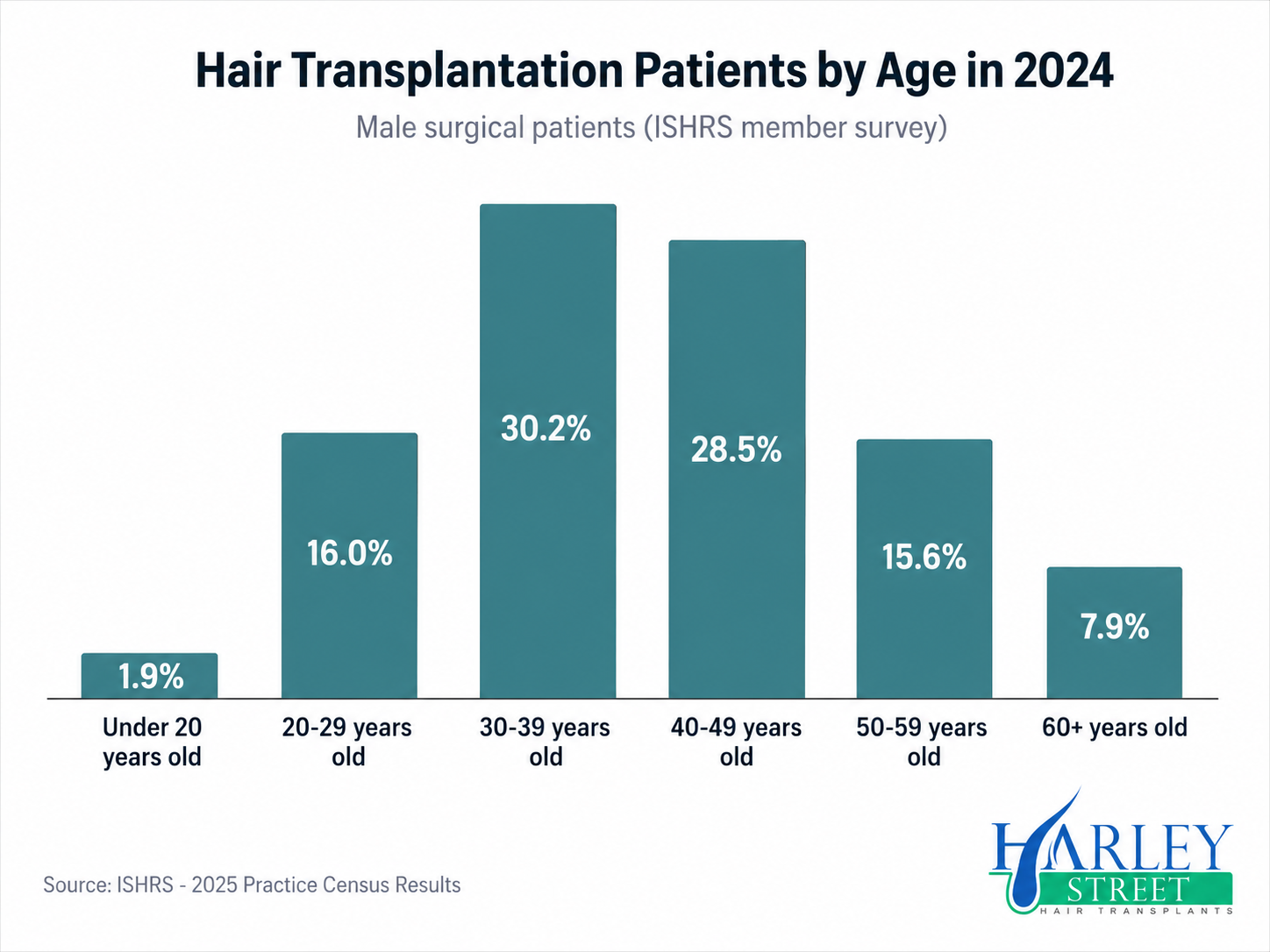
The largest age groups for both men and women were between 30 and 49. Male surgical patients were slightly younger overall than female patients.

Hair transplant patients by age in 2024
Age Male patients Female patients
Under 20 1.9% 2.1%
20–29 16.0% 16.2%
30–39 30.2% 29.5%
40–49 28.5% 24.5%
50–59 15.6% 17.7%
60+ 7.9% 10.1%

When are patients having their first transplant?

Among first-time surgical patients, 57.6% were aged 26–35 and 37.3% were aged 20–25. Together, those two groups account for the overwhelming majority of first-time surgery reported by respondents.

The census also found that 73.0% of responding physicians used a minimum-age cut-off for younger patients. Among those physicians, the average minimum was 22 and the median was 23.

For older patients, 80.0% of respondents said they did not impose a fixed maximum age. Among those who did, the average reported maximum was 72.

Which parts of the body are being transplanted?

Scalp restoration remains dominant, representing 81.6% of male procedures and 78.9% of female procedures.

Among men, approximately 4.9% of procedures involved the beard or moustache, 4.4% involved eyebrows, 2.7% involved scar repair and 4.1% involved repair following a previous black-market transplant. Patients researching facial restoration can read more about beard transplantation.

For women, the eyebrow was the most commonly reported non-scalp recipient area, accounting for 12.2%. Our eyebrow transplant guide explains how graft selection, direction and brow design differ from scalp restoration.

Are transgender hair transplants increasing?

39.8% of participating physicians reported an increase in transgender hair transplantation within their practices, while 58.5% reported no change. Among physicians who treated transgender patients in 2024, scalp transplantation was the most commonly reported treatment at 81.9%.

Our transgender hair transplant guide covers hairline, scalp and facial-hair restoration according to the individual's treatment goal.

What about Afro-textured hair?

Afro-textured and tightly curled hair can be transplanted, but follicular curvature beneath the skin can make extraction technically different from straight hair. The direction visible above the scalp does not necessarily show the full path of the follicle beneath it.

Hair calibre and curl can also influence visual coverage: a smaller number of thicker, curled hairs can sometimes create a different appearance of density from the same number of finer straight hairs. Assessment therefore needs to consider the donor area's density, calibre, curl pattern and likely extraction behaviour rather than treating every hair type in the same way.

Why do people have hair transplants?

Hair transplantation is usually prompted by a combination of the underlying cause of hair loss and the patient's personal reason for wanting restoration. The latest census asked physicians which motivations their patients most commonly reported.

90.0%
become or feel more attractive.
62.7%
appear younger in order to compete in the workplace.
59.2%
improve appearance for an upcoming event such as wedding or graduation photographs.
36.1%
a spouse wanted the patient to appear younger.
24.9%
getting divorced.
12.4%
covering the scalp to help protect it from sun exposure.

What type of hair loss is being treated?

The patient's motivation for having surgery should not be confused with the medical or cosmetic reason hair restoration is being considered. Genetic hair loss remains by far the largest treatment category.

  • 70.9% — genetic hair loss
  • 6.9% — dermatological, metabolic, hormonal, nutritional or medication-induced hair loss
  • 6.9% — repair following earlier surgery or a black-market transplant
  • 4.3% — stress-related hair loss
  • 4.1% — reconstructive treatment needs
  • 3.9% — post-cosmetic-surgery treatment needs
  • 2.8% — transgender treatment needs

Do patients tell other people they had a transplant?

Hair transplantation is becoming more openly discussed, although attitudes remain mixed. When physicians were asked whether the majority of their patients planned to tell friends, family and co-workers about their surgery, 44.1% answered yes, 31.8% were unsure and 24.1% answered no.

How common is a second hair transplant?

The census did not simply ask how many individual patients had undergone a second transplant. It asked participating physicians how many procedures they performed on average to achieve the desired restoration result.

67.3% of physicians reported an average of one procedure per patient
30.8% reported an average of two procedures
1.9% reported three or more procedures

Across the responses, the mean was 1.5 procedures and the median was one.

Why might somebody have another transplant?

One reason is progression of the patient's original hair loss. A transplant moves selected donor follicles into an area that has thinned or become bald, but native non-transplanted hair around those grafts can continue to thin later.

Another reason is staged restoration. A patient with extensive loss may prioritise the frontal area first and consider additional treatment elsewhere later rather than attempting to restore every area during one procedure.

How long does a hair transplant last?

Hair is normally selected from donor regions that are more resistant to androgenetic hair loss. Successfully established transplanted follicles can therefore continue producing hair for many years.

That does not freeze the remainder of the scalp in time. Existing hair outside the transplanted area can continue to miniaturise, which is why the future pattern of hair loss can affect how a result looks years after surgery.

What non-surgical hair-loss treatments are specialists using?

The 2025 census also asked physicians how often different non-surgical treatments were prescribed or recommended during 2024. The figures below show the proportion answering “always” or “often”.

72.3%
oral finasteride 1mg.
64.7%
oral minoxidil.
55.3%
topical minoxidil 2% or 5% solution.
52.0%
topical minoxidil 5% foam.
49.8%
platelet-rich plasma treatment.

The survey measures prescribing patterns among participating physicians, not how effective one treatment will be for an individual patient. At our clinic, PRP hair treatment can be discussed as a non-surgical option for selected patients with thinning or reduced density.

What about laser and photobiomodulation treatments?

Home-use low-level light or photobiomodulation was reported as being prescribed or recommended often or always by 24.6% of respondents. In-office low-level laser or photobiomodulation treatment was reported by 31.2%.

What is the success rate of a hair transplant?

There is no single current ISHRS percentage that can accurately be described as the universal success rate of hair transplantation. “Success” can refer to graft survival, visible growth, density, natural appearance or patient satisfaction, and those are not the same measurement.

For that reason, percentages quoted by individual clinics should be checked to see exactly what was measured, how it was measured and over what follow-up period.

What does a failed hair transplant look like?

A poor result can involve lower-than-expected growth, insufficient density, an unnatural hairline, incorrect graft direction, visible donor depletion, excessive scarring or a complication that interferes with healing.

What can contribute to a poor result?

  • Patient selection: the diagnosis, scalp condition, donor supply and likely progression of hair loss all affect whether surgery is appropriate.
  • Donor management: extraction that is excessive or badly distributed can leave visible thinning and reduce future donor options.
  • Graft handling: follicular units can be damaged during extraction, preparation, storage or implantation.
  • Recipient-site design: hairline shape, graft angle, direction, spacing and distribution influence whether growth looks natural.
  • Healing complications: bleeding, infection and other postoperative problems can affect recovery.
  • Aftercare: the recipient area requires appropriate care while the grafts settle and the scalp heals.

What is a black-market hair transplant?

The ISHRS uses the term “black market” when discussing hair-restoration surgery performed without appropriate physician involvement, licensing, medical oversight or professional standards.

In the latest census, 59.4% of members reported black-market hair-transplant clinics operating in their city. Among repair work seen by respondents, the average percentage of cases attributed to previous black-market transplantation was 10%, with a median of 5%.

Is hair transplant surgery safe?

The NHS describes hair transplantation as generally safe, but it remains an operation. Recognised risks include bleeding, infection, an allergic reaction to anaesthetic, scarring and the possibility that some transplanted hair does not take.

There is no reliable universal mortality percentage published by the NHS or the current ISHRS census for hair-transplant surgery, so claims that the fatality rate is literally zero should not be presented as an established statistic.

What happens after a hair transplant?

First 2 weeks The grafted area requires particular care while early healing takes place.
Following weeks The transplanted hair shafts can shed before new growth becomes established.
Around 4 months Early new hair usually begins appearing.
10–18 months The final result can continue developing throughout this period.

Our hair transplant timeline explains the growth stages in more detail. Temporary postoperative shedding and shock loss are covered separately, while the aftercare guide explains washing, sleeping, exercise and scalp care after surgery.

How much does a hair transplant cost in the UK?

The NHS gives a broad UK hair-transplant price range of approximately £1,000 to £30,000. The amount can vary substantially because the treatment area, level of hair loss, procedure, graft requirement and clinic are different from one patient to another.

At Harley Street Hair Transplants, surgical treatment currently starts from £3,499. Our hair transplant cost page explains current prices and how treatment area, estimated graft numbers, donor characteristics and procedure type affect a quotation.
Dr Harpreet Kalra

Dr Harpreet Kalra

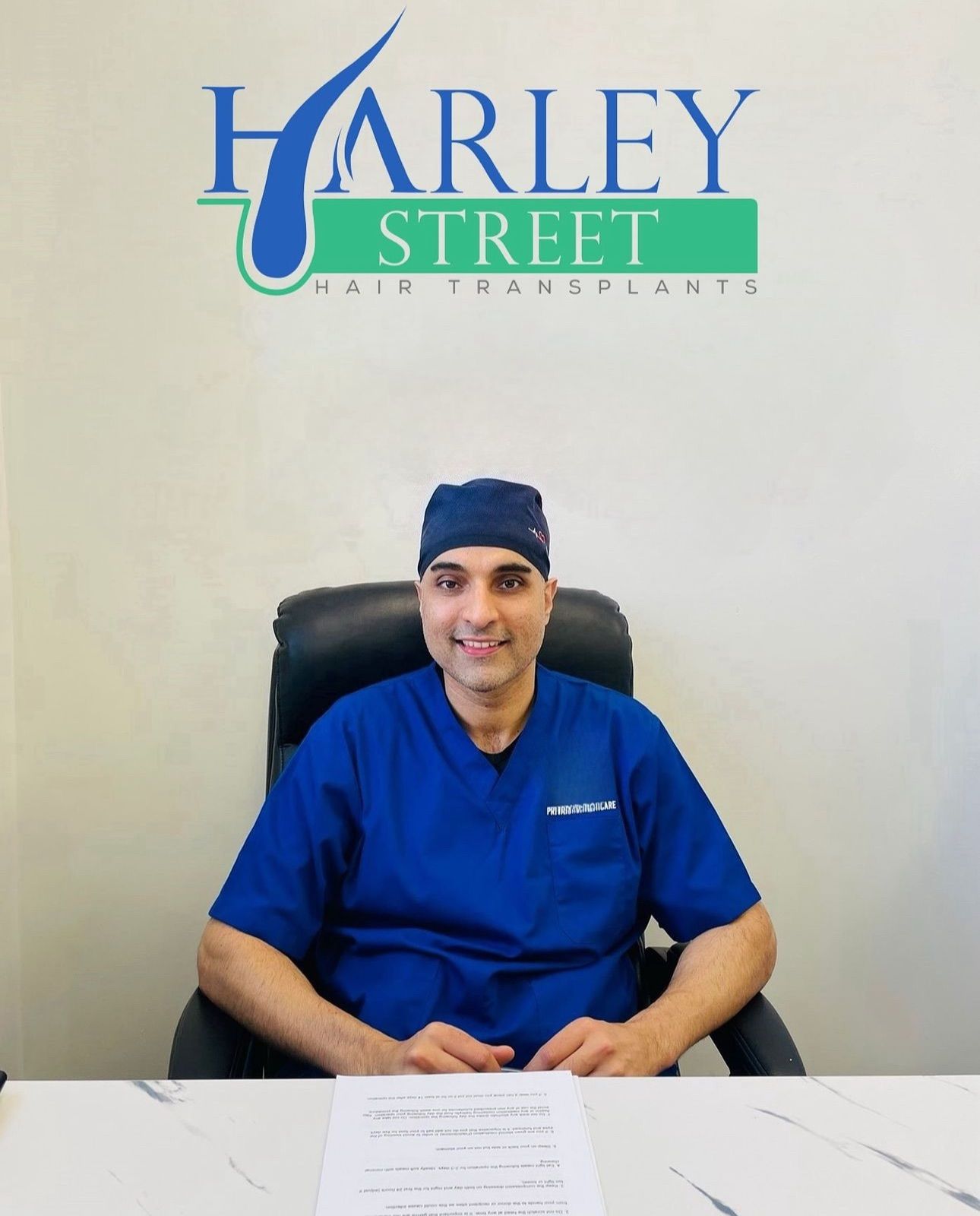
Dr Harpreet Kalra is our Principal Hair-Transplant Surgeon, GMC reference 7126076. Assessment includes the patient's hair-loss pattern, donor-area strength, scalp health, medical history and proposed restoration plan.

Hair transplant statistics FAQs

What is the most common hair transplant method?

FUE is the dominant donor-harvesting technique in the latest census. It accounted for 85.4% of male surgical procedures and 68.2% of female procedures reported by participating physicians.

What percentage of hair transplant patients are men?

84.7% of surgical hair-restoration patients reported in the 2024 data were male and 15.3% were female.

What age do most people have their first hair transplant?

57.6% of first-time surgical patients were aged 26–35 and 37.3% were aged 20–25.

How many grafts are used in an average hair transplant?

The latest census reported an average of 2,347 grafts for a first surgical procedure and 1,637 grafts for a subsequent procedure.

Where does donor hair normally come from?

The scalp represented 91.7% of FUE donor harvesting in the latest census. Beard hair represented 6.1% and chest hair 1.1%.

How common is a second hair transplant?

30.8% of responding physicians reported performing an average of two procedures per patient to achieve the desired result. 67.3% reported an average of one procedure and 1.9% reported three or more.

Is a hair transplant permanent?

Successfully established donor follicles can provide long-lasting growth. However, native hair surrounding the transplanted area can continue to thin as the patient's original hair-loss pattern progresses.

What is the success rate of a hair transplant?

There is no single universal percentage in the current ISHRS census. Graft survival, visible growth, density and cosmetic outcome are different measurements and should not be combined into one generic success figure.

Can Afro-textured hair be transplanted?

Yes. Afro-textured and tightly curled hair can be transplanted in suitable patients, although follicular curvature beneath the skin can make donor extraction technically different from straight hair.

How much does a hair transplant cost in the UK?

NHS guidance gives a broad UK range of approximately £1,000–£30,000. Harley Street Hair Transplants currently lists surgical treatment from £3,499.

Clinical and statistical sources

International Society of Hair Restoration Surgery: 2025 Practice Census

International Society of Hair Restoration Surgery: Full 2025 Practice Census Results

International Society of Hair Restoration Surgery: 2022 Practice Census and worldwide estimates

NHS: Hair transplant guidance

Considering a hair transplant?

A consultation can assess your hair-loss pattern, donor area, scalp condition, treatment options, likely graft requirements and expected costs before deciding whether surgery is suitable.

Book a Free Consultation View Patient Results

Latest hair transplant articles