
The Ludwig Scale
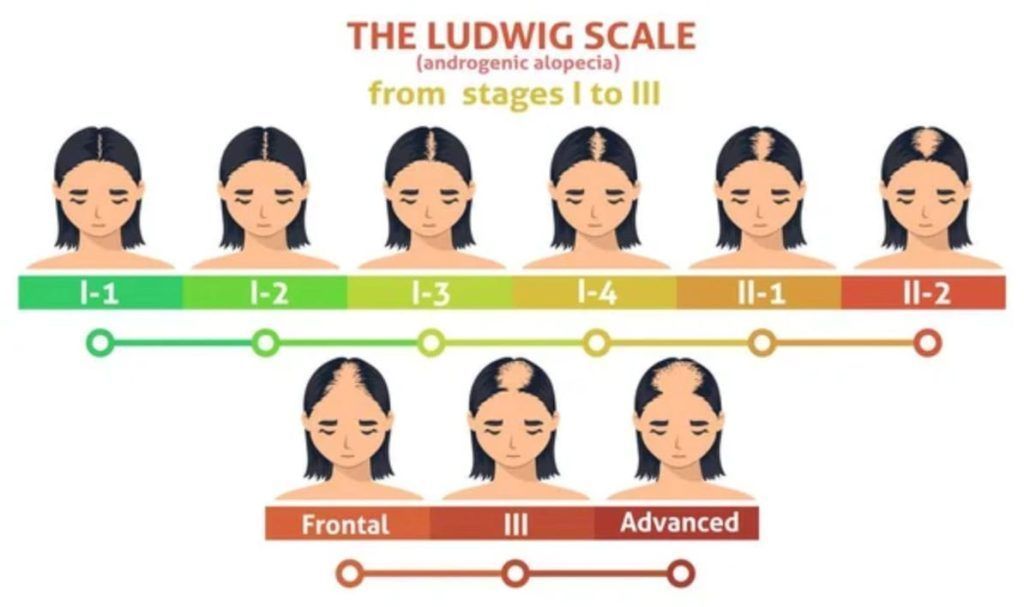
The Ludwig Scale is a classification system used to describe the severity of female pattern hair loss, particularly progressive thinning through the central and upper scalp.
Unlike the typical recession pattern described by the Norwood Scale, female pattern hair loss more commonly produces a widening parting and reduced density across the top of the scalp while the frontal hairline remains comparatively preserved.
The classic Ludwig system contains three grades: Ludwig I, Ludwig II and Ludwig III. As the grade increases, the central parting generally becomes wider and visible density through the upper scalp decreases.
The scale is useful for describing the visible extent of thinning and monitoring change over time, but it does not diagnose the underlying cause of hair loss or determine treatment by itself.
What Does the Ludwig Scale Measure?
The Ludwig Scale describes the visible reduction in hair density across the central and upper scalp. It is most useful when thinning follows the broad pattern commonly associated with female pattern hair loss.
Early changes may be subtle. The central parting can gradually become wider, the scalp may become more noticeable under bright light, and overall hair volume can decrease even though substantial hair remains throughout the affected area.
As more follicles become miniaturised, the hairs they produce tend to become finer and provide less effective coverage. This can make the scalp progressively easier to see through the remaining hair.
What the Ludwig Scale Does Not Measure
A Ludwig grade does not measure the exact number of follicles present, donor density, the amount of active shedding or the rate at which the condition will progress.
Two women with the same visible grade can therefore have different hair thickness, scalp dimensions, degrees of miniaturisation and long-term patterns of loss.
Is a Ludwig Grade a Diagnosis?
No. The scale describes how the thinning appears. It does not establish why the hair has become thinner.
Female pattern hair loss is one possible cause, but diffuse thinning can also occur because of other medical, hormonal, nutritional or scalp-related conditions.
Ludwig Grades I, II and III
Ludwig Grade I
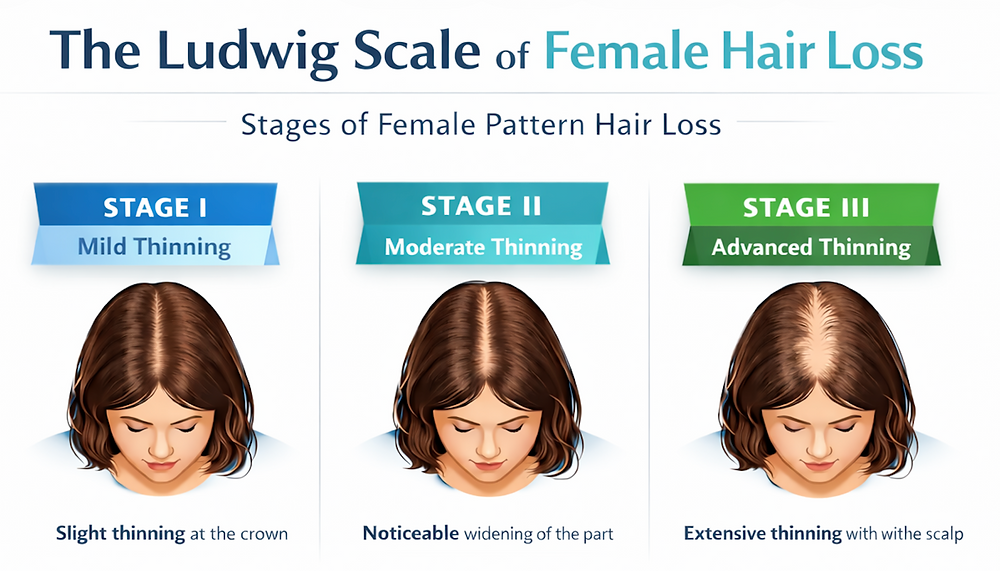
Ludwig I describes early thinning. The central parting may begin to widen and density through the upper scalp may be slightly reduced while the frontal hairline remains comparatively well preserved.
At this stage, the change may be easiest to notice when styling the hair or comparing photographs taken over time.
Ludwig Grade II
Ludwig II describes more established thinning. The central parting becomes broader, scalp visibility increases and the remaining hair provides less coverage across the top of the head.
The reduction in density is usually more apparent under ordinary lighting and may become increasingly difficult to disguise through styling alone.
Ludwig Grade III
Ludwig III represents advanced thinning across the central and upper scalp. Density is substantially reduced and the scalp is clearly visible through a larger area.
Advanced visible loss does not automatically mean that surgery is appropriate. Diagnosis, donor stability, recipient-area size and realistic treatment expectations still need to be considered.
How Is a Ludwig Grade Assessed?
A Ludwig grade is usually based on the visible distribution and severity of thinning, but a proper assessment should look beyond the nearest matching illustration.
The history of the hair loss matters. This includes when the change began, whether it has been gradual or sudden, whether active shedding is occurring and whether similar thinning occurs within the family.
Scalp Examination
Examination can assess the overall pattern, scalp condition and differences in hair-shaft thickness. Variation in hair diameter and progressive follicular miniaturisation can support a diagnosis of female pattern hair loss.
Where the history or examination is unusual, further medical assessment may be more appropriate than assigning a Ludwig grade and immediately discussing cosmetic treatment.
Monitoring Change Over Time
Photographs can be useful when they are taken under comparable conditions. Lighting, parting position, wet or dry hair, styling and camera angle can all alter how much scalp is visible.
Progression is therefore better assessed using consistent photographs over a longer period rather than comparing isolated images taken under different conditions.
Ludwig Scale vs Norwood Scale
The Ludwig and Norwood systems both classify patterned hair loss, but they describe different distributions.
The Norwood Scale is mainly used for the characteristic male pattern involving the frontal hairline, temples, mid-scalp and crown.
The Ludwig Scale describes diffuse thinning through the central and upper scalp, often with considerably less recession at the frontal hairline.
Is Every Widening Parting Female Pattern Hair Loss?
No. A widening parting simply shows that density has reduced in that area. It does not establish the cause.
Diffuse shedding, hormonal or nutritional problems and other types of hair loss can sometimes create a similar appearance.
When the Ludwig Scale May Not Be Appropriate
Sudden hair loss, clearly defined patches, scalp inflammation, pain, scarring or unusual frontal recession may indicate a different process.
In those cases, establishing the diagnosis is more important than trying to fit the scalp into Ludwig Grade I, II or III.
Does Ludwig Grade Determine Treatment?
No. The Ludwig grade describes visible severity. Treatment should be based on the underlying diagnosis, rate of progression, age, medical history and the condition of the remaining hair.
Medical Treatment
Where the diagnosis is female pattern hair loss, medical treatment may be considered to help slow progression or improve the performance of follicles that remain active.
Treatment suitability varies, and medication should be considered in the context of individual medical history and potential risks rather than simply because somebody has been assigned a particular Ludwig grade.
PRP Hair Treatment
PRP is sometimes considered for thinning hair, but it does not create or transplant new follicles and should not be presented as a guaranteed treatment for female pattern hair loss.
Cosmetic Options
Hair fibres, hairpieces, changes in styling and other cosmetic approaches can reduce the visible contrast between the scalp and remaining hair without altering the underlying follicular process.
Hair Transplant Suitability in Women
Some women with stable female pattern hair loss may be suitable for hair transplantation, but the Ludwig grade alone cannot determine whether surgery is appropriate.
Hair transplantation redistributes existing follicles from one part of the scalp to another. It therefore depends on having a donor area that is sufficiently dense, stable and suitable for harvesting.
This is particularly important in women because diffuse thinning can sometimes extend beyond the central scalp and affect areas that might otherwise be considered for donor harvesting.
FUE Hair Transplant
Where surgery is appropriate, FUE is one method that may be considered. Individual follicular-unit grafts are removed from a suitable donor area and transferred into carefully planned areas of thinning.
FUE does not stop the underlying tendency for untreated native hair to continue thinning, and it is not automatically the best surgical method for every woman.
Donor density, the distribution of hair loss, scalp condition, hair calibre, existing native hair and the size of the recipient area all need to be assessed before a surgical method is recommended.
Donor Area Assessment
A strong donor area is essential because transplanted follicles have to come from somewhere. The donor supply is finite and needs to be preserved rather than treated as an unlimited source of grafts.
If the donor region shows significant miniaturisation or diffuse thinning, removing follicles from that area may reduce density further and make transplantation unsuitable.
Hair-shaft thickness, follicular grouping, donor density and the stability of the surrounding hair also affect how much useful coverage may be possible.
A Ludwig Grade Is Not a Graft Estimate
A Ludwig grade cannot be converted into a fixed graft number. Two women with the same visible degree of thinning can have very different scalp dimensions, donor density, hair characteristics and amounts of existing native hair.
Graft requirements should therefore follow assessment of both the donor and recipient areas rather than being estimated from the Ludwig illustration alone.
Future Hair Loss Still Matters
Transplanted follicles can improve coverage in selected areas, but surgery does not prevent untreated native hair from continuing to thin.
Long-term planning therefore needs to consider the likely progression of the surrounding hair as well as the area that is already visibly affected.
Discuss Your Hair Loss
Ludwig Scale FAQs
What is the Ludwig Scale?
How many Ludwig grades are there?
What is Ludwig Grade I?
What is Ludwig Grade II?
What is Ludwig Grade III?
Does the Ludwig Scale diagnose female pattern hair loss?
Is the Ludwig Scale the same as the Norwood Scale?
Can a Ludwig grade tell me how many grafts I need?
Can women with Ludwig pattern hair loss have a hair transplant?
Medical Information Sources
Clinical information about female pattern hair loss and its assessment is informed by the British Association of Dermatologists.
General information about hair loss and when medical assessment may be appropriate is informed by NHS hair-loss guidance.
Medical Information
This page provides general educational information about the Ludwig Scale and female pattern hair loss. The Ludwig Scale describes visible severity but does not diagnose the cause of hair loss. Sudden, patchy, painful, inflamed or unexplained hair loss should be medically assessed before treatment is considered.