
Women’s Hair Loss and Female Pattern Baldness
Female pattern baldness, also known as female pattern hair loss or androgenetic alopecia, is a progressive form of hair thinning that commonly affects the central parting and upper scalp.
It often develops differently from male pattern baldness. Rather than producing a strongly receding frontal hairline, many women notice a widening parting, reduced hair volume and increasing visibility of the scalp through the top of the head.
The pattern and rate of progression vary between individuals. Some women develop relatively mild central thinning while others gradually lose density across a broader area of the upper scalp.
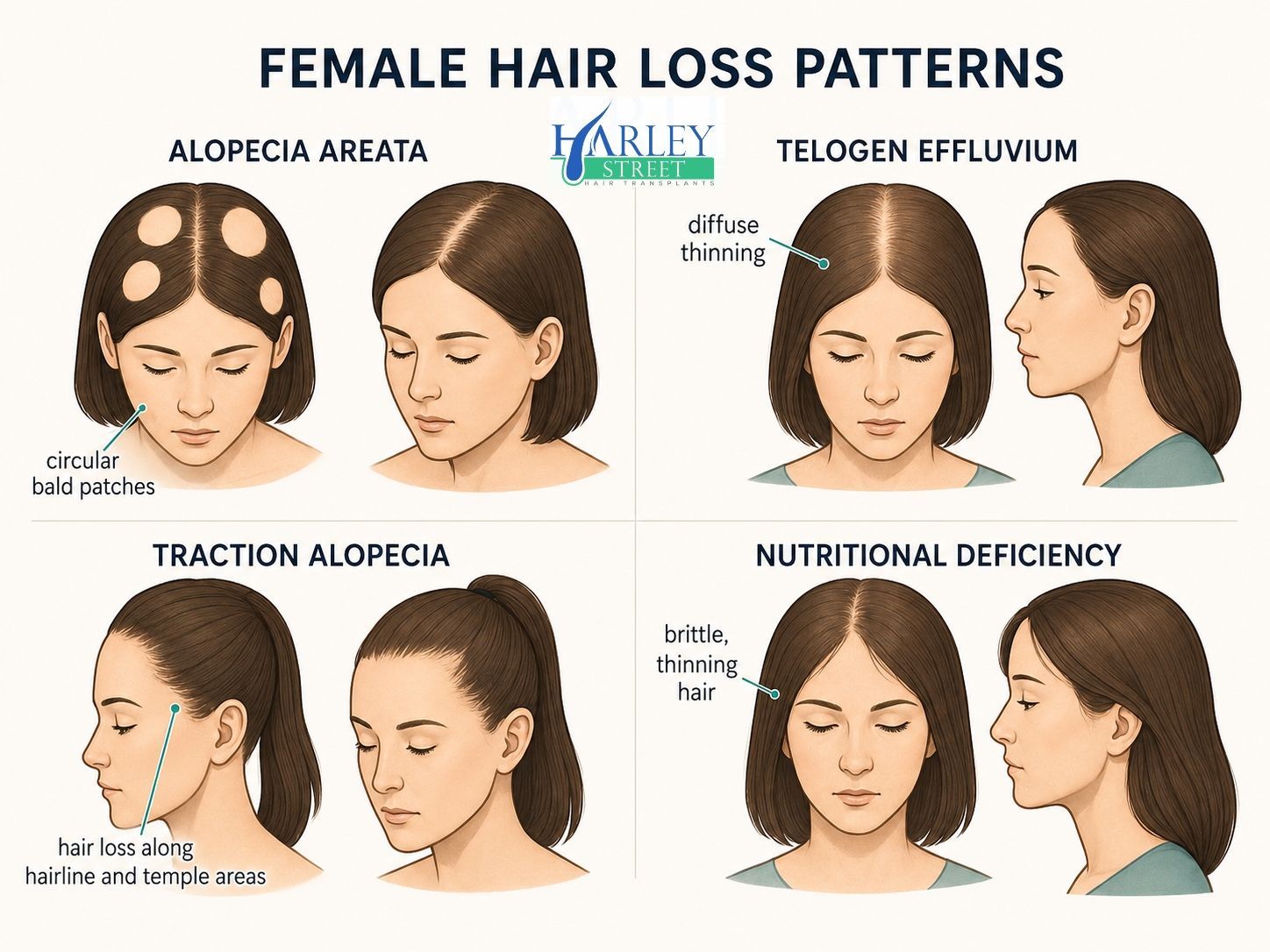
The cause should be established before treatment is recommended because diffuse thinning in women can also occur after illness, pregnancy, nutritional deficiency, hormonal change, traction or other medical and scalp conditions.
What Is Female Pattern Hair Loss?
Female pattern hair loss is a form of non-scarring alopecia in which susceptible scalp follicles gradually produce hairs that are finer, shorter and less visually substantial.
This process is known as follicular miniaturisation. A follicle that previously produced a strong terminal hair can begin producing progressively finer hairs over repeated growth cycles.
As more follicles become miniaturised, overall hair volume decreases and the scalp becomes increasingly visible through the remaining hair.
The change is often most noticeable through the central parting and upper scalp. Rather than developing a completely bald patch, many women retain hair throughout the affected area but with progressively reduced density.
How Does Female Pattern Hair Loss Differ From Male Pattern Baldness?
Male pattern baldness commonly produces recession through the temples and frontal hairline before extending through the top of the scalp or crown.
Female pattern hair loss more commonly produces diffuse thinning through the central and upper scalp. The middle parting may become progressively wider while the frontal border of the hairline remains comparatively well preserved.
This distinction is not absolute. Women can develop frontal recession, localised thinning or other patterns, and several unrelated forms of hair loss can resemble early female pattern baldness.
Diagnosis should therefore be based on the overall pattern, progression and scalp assessment rather than the appearance of one area alone.
What Happens to the Hair Follicles?
Hair grows in repeated cycles. In female pattern hair loss, susceptible follicles progressively produce smaller hairs and spend less time producing strong terminal growth.
This means that visible density can fall gradually even when the scalp still contains many active follicles. Early changes may therefore appear as loss of volume rather than obvious baldness.
The degree of miniaturisation matters when treatment is being considered because follicles that are still active may respond differently from areas where very little useful hair remains.
What Causes Female Pattern Baldness?
Female pattern hair loss is influenced by a combination of inherited susceptibility and hormonal factors. The exact biological process is more complex than simply having an unusually high level of one hormone.
Susceptible follicles gradually miniaturise, producing finer hairs and reducing visible scalp density over time.
Is Female Pattern Hair Loss Hereditary?
Female pattern hair loss can run in families. Genetic susceptibility may be inherited from either or both parents, and relatives within the same family can still develop different degrees and patterns of thinning.
At What Age Can Female Pattern Baldness Start?
Female pattern hair loss is more often recognised later in adult life, but it can develop earlier. Some women first notice changes in their thirties or forties, while others do not develop obvious thinning until their fifties, sixties or later.
Progression is generally gradual and may take place over years or decades. Earlier onset can sometimes be associated with more rapid progression.
Hormones, PCOS and Female Hair Loss
Some women with female pattern hair loss also have conditions associated with increased androgen activity, including polycystic ovarian syndrome.
Acne, increased facial or body hair, irregular menstrual cycles or fertility problems alongside scalp hair loss may justify further medical assessment rather than assuming the hair loss is purely cosmetic.
What About Menopause?
Hair density often changes with age, and female pattern loss may become increasingly noticeable around later adult life. Menopause should not, however, be treated as the sole explanation for every case of thinning.
A widening parting after menopause can still require assessment for pattern hair loss, thyroid problems, nutritional deficiency, medication effects or another cause of diffuse shedding.
Signs of Female Pattern Baldness
Female pattern hair loss is usually gradual. Many women first become aware of a change while styling their hair rather than noticing a clearly bald area.
- a central parting that appears progressively wider;
- increasing visibility of the scalp through the top of the head;
- reduced overall hair volume;
- a ponytail that feels thinner than previously;
- finer hairs through the central or upper scalp;
- gradual diffuse thinning rather than sharply defined bald patches;
- the frontal hairline remaining relatively intact despite thinning behind it.
How Is Female Pattern Hair Loss Diagnosed?
Diagnosis usually begins with the history and distribution of the loss. The clinician should consider when the change began, whether shedding is active, family history, medication, menstrual and hormonal history where relevant, scalp symptoms and other medical factors.
The scalp often looks otherwise normal in straightforward female pattern hair loss. Examination can also assess variation in hair thickness and signs of follicular miniaturisation.
Blood tests or further medical investigation may be appropriate when the history suggests another cause. Occasionally a scalp biopsy is used where the diagnosis remains uncertain.
Ludwig Scale for Female Pattern Hair Loss
The Ludwig scale is one method used to describe the visible severity of female pattern thinning. It is a descriptive classification rather than a treatment recommendation.
Not All Female Hair Loss Is Female Pattern Baldness
Diffuse thinning has several possible causes. Establishing what is happening is particularly important before hair-transplant surgery because some forms of hair loss are temporary, actively progressive or capable of affecting the proposed donor area.
Telogen Effluvium
Telogen effluvium causes increased diffuse shedding after disruption to the normal hair cycle. Possible triggers include illness, surgery, major psychological or physical stress, rapid weight change and nutritional problems.
The pattern can resemble early female pattern hair loss, and the two conditions can sometimes occur together.
Postpartum Hair Shedding
Increased shedding can occur after pregnancy as follicles move through changes in the hair-growth cycle. This is different from automatically diagnosing permanent female pattern baldness.
Traction Alopecia
Repeated tension from tight hairstyles, braids, extensions or other styling practices can damage follicles, particularly around the frontal and temporal hairline.
Early traction loss may behave differently from longstanding loss where permanent follicular damage has occurred.
Alopecia Areata
Alopecia areata commonly causes clearly defined areas of hair loss rather than the gradual central thinning typical of female pattern hair loss. It is an autoimmune condition and requires a different treatment approach.
Scarring Hair Loss
Some inflammatory conditions can permanently damage follicles and produce scarring alopecia. Redness, pain, burning, marked scaling, loss of follicular openings or progressive frontal recession should be medically assessed.
Iron, Thyroid and Other Medical Causes
Iron deficiency, thyroid disease, significant dietary restriction, medication and other medical conditions may contribute to shedding or reduced density.
Read our broader hair loss guide for the distinction between patterned, temporary, patchy and medically related hair loss.
Can Female Pattern Baldness Be Prevented?
There is currently no treatment that removes the inherited susceptibility responsible for female pattern hair loss.
Treatment is therefore usually aimed at slowing progression, supporting follicles that remain active and improving the visible appearance of reduced density.
This is different from correcting temporary shedding caused by an identifiable medical or physiological trigger. It is also different from transplantation, which physically redistributes follicles rather than treating the underlying tendency of existing susceptible hairs to miniaturise.
Topical Minoxidil
Minoxidil is one of the principal treatments used for female pattern hair loss. Applied to the scalp, it may slow progression and partially improve hair density in some women.
Response varies and treatment generally has to continue for the benefit to be maintained. An initial increase in shedding can occur during the early weeks, and scalp irritation, dryness, redness or unwanted facial hair growth can occur in some users.
Minoxidil should not simply be started during pregnancy, while trying to conceive or while breastfeeding without appropriate medical advice.
Oral Minoxidil
Low-dose oral minoxidil may be considered by a clinician in selected cases. Because it acts throughout the body rather than only on the scalp, suitability and potential systemic effects require medical assessment and monitoring.
It should not be treated as an over-the-counter substitute for individual medical review.
Anti-Androgen Treatment
Specialist clinicians may consider anti-androgen medicines such as spironolactone in selected women. These treatments are not appropriate for everyone and may be prescribed outside their licensed indication for female pattern hair loss.
Pregnancy and breastfeeding considerations are particularly important with anti-androgen treatment, so medication decisions should be made with an appropriate prescribing clinician.
PRP Hair Treatment
Platelet-rich plasma uses plasma prepared from the patient's own blood and introduces it into selected areas of thinning scalp.
PRP should not be presented as a cure for female pattern baldness. Research remains limited and it is not possible to predict reliably which patients will benefit.
Hair Fibres, Wigs and Cosmetic Camouflage
Hair fibres, hairpieces, wigs and changes in styling can reduce visible scalp contrast without altering the underlying follicular process.
For some women these are useful primary options; for others they may be used alongside medical treatment.
Can Female Pattern Baldness Be Treated With a Hair Transplant?
Some women with stable hair loss may be suitable for hair transplantation, but female pattern hair loss requires particularly careful assessment.
A transplant does not create new follicles. It moves suitable follicular units from a donor area into a selected recipient area. The procedure therefore depends on having donor hair that is sufficiently dense and stable.
This is especially important in women because diffuse miniaturisation can sometimes extend into areas that would normally be considered for donor harvesting.
When Surgery May Be Considered
- stable localised thinning with a sufficiently strong donor area;
- a naturally high or uneven frontal hairline;
- selected stable temple recession;
- selected widening-parting or crown concerns after proper assessment;
- stable traction-related hairline loss where the damaging traction has stopped;
- selected localised or scar-related areas.
When a Hair Transplant May Not Be Suitable
- active or unexplained diffuse shedding;
- widespread miniaturisation affecting the proposed donor region;
- untreated inflammatory or scarring scalp disease;
- a medical cause of hair loss that requires investigation;
- ongoing traction or styling damage;
- insufficient donor density for the area requiring coverage.
Why the Donor Area Matters
Hair transplantation redistributes a limited donor supply. Density, hair calibre, texture, follicular grouping and the stability of the donor region all influence whether surgery is realistic.
Where thinning extends across a large area of the scalp, the number of follicles required to create meaningful coverage can exceed what can safely be removed from the donor region.
FUE, DHI or FUT?
Selected female patients may be assessed for FUE, DHI or FUT depending on donor characteristics, treatment area, graft requirement, scar preference and whether donor shaving or trimming is appropriate.
The procedure name should come after the diagnosis and donor assessment rather than being chosen before suitability has been established.
Recovery After Female Hair Transplant Surgery
Recovery depends on the donor method, the recipient area and whether grafts are being placed into an area that still contains substantial native hair.
Early redness, tenderness, swelling and small recipient-area scabs can occur. Transplanted hairs may subsequently shed before new growth develops gradually over the following months.
Hair Transplant Aftercare
Early aftercare focuses on protecting the newly placed grafts, washing correctly, avoiding unnecessary rubbing and following the supplied advice for exercise, styling and scalp care.
Shedding and Shock Loss
Grafts placed between existing thinning hairs can be followed by temporary postoperative shedding. This can make an already thin area appear temporarily less dense during early recovery.
Hair Transplant Growth Timeline
Final density is not visible immediately after treatment. New growth develops over months and continues to mature, so an early postoperative appearance should not be treated as the final result.
Female Hair Transplant Results
Results should be interpreted alongside the original cause of hair loss, donor strength, existing native hair, graft requirement and the point in the growth timeline when photographs were taken.
Discuss Your Female Hair Loss
Female Pattern Baldness FAQs
Is female pattern baldness the same as androgenetic alopecia?
What does female pattern baldness usually look like?
Does female pattern baldness cause complete baldness?
Is female pattern hair loss hereditary?
Can female pattern baldness start before menopause?
Can female pattern baldness be cured?
Does minoxidil work for female pattern hair loss?
Can women with female pattern baldness have a hair transplant?
Is a widening parting always female pattern baldness?
When should female hair loss be medically assessed?
Medical Information Sources
Clinical information on female pattern hair loss, follicular miniaturisation, diagnosis and treatment is informed by the British Association of Dermatologists.
General information on hair loss, possible causes and when to seek medical assessment is also informed by NHS hair-loss guidance.
Medical Information
This page provides general information about female pattern hair loss and is not a substitute for an individual medical diagnosis, examination or treatment plan.
Hair loss in women can have several different causes. If your hair loss is sudden, severe, patchy, painful, associated with scalp inflammation or scarring, or you are uncertain what is causing it, seek medical assessment before considering treatment at a commercial hair clinic.
Treatment suitability varies between patients. Medication and hair-transplant surgery should only be considered after the cause and pattern of hair loss, relevant medical history and individual treatment risks have been assessed.