
Norwood Stages of Hair Loss
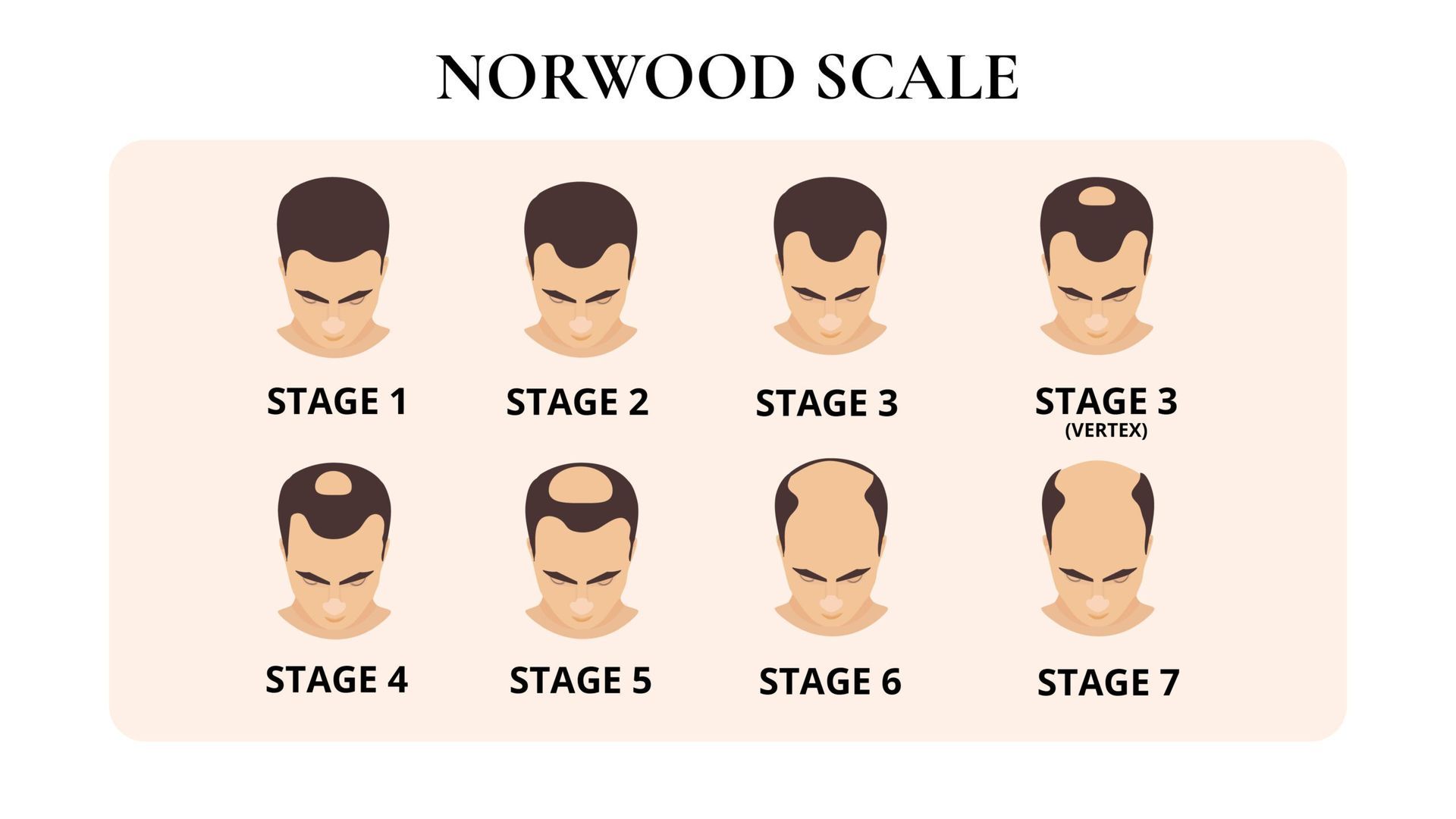
The Hamilton–Norwood scale is a classification system used to describe common patterns of male pattern hair loss, from minimal hairline change through to extensive loss across the frontal scalp, mid-scalp and crown.
Knowing the approximate stage can make consultations easier, but the stage alone cannot determine whether someone should have a hair transplant. Donor density, hair calibre, age, progression, scalp health, treatment goals and the amount of future hair loss all matter.




What Is the Norwood Scale?
The scale provides a common language for describing the location and extent of male pattern hair loss. It is useful for documenting change over time and discussing potential treatment, but it is only one part of a full hair-loss assessment.
What Does It Measure?
The Norwood system primarily looks at the pattern of recession through the frontal hairline and temples together with thinning or baldness around the vertex or crown.
The conventional numbered pattern progresses from Stage 1 through Stage 7, with additional patterns such as Stage 3 Vertex and the Type A variants.
A higher number generally describes a larger area of established pattern hair loss. It does not mean that every person will progress through every stage.
Why Is the Scale Useful?
A classification gives patients and clinicians a consistent way to discuss whether the main concern is frontal recession, temple loss, crown thinning or a larger combined area.
- Documents the visible pattern of male hair loss.
- Helps compare change over time.
- Provides context for recipient-area size.
- Helps frame discussions about hairline and crown priorities.
- Supports long-term donor-supply planning.
What Does the Scale Not Tell You?
The scale does not measure donor density, hair-shaft thickness, miniaturisation throughout the donor area, scalp laxity, hair texture or the number of grafts that can be harvested safely.
It also cannot predict exactly how quickly someone's hair loss will progress.
Two people who both appear to be Stage 4 can therefore have very different treatment options.
Why Does Male Pattern Hair Loss Develop?
Androgenetic alopecia involves genetically susceptible follicles that progressively miniaturise. In men, the front, temples, mid-scalp and crown commonly show the most recognisable patterned change.
Over successive hair cycles, susceptible follicles can produce shorter, finer hairs, reducing visible density.
Not every form of hair loss follows the Norwood pattern. Sudden, patchy, inflammatory, scarring or diffuse hair loss may require a different diagnostic approach.
Our hair loss guide explains the distinction between common causes and patterns in more detail.
Does Everyone Progress to Stage 7?
No. Some men remain at an earlier pattern for many years, while others develop more extensive loss.
The current stage is therefore a description of the visible pattern, not a guaranteed forecast of the eventual pattern.
Age, previous change, family history, miniaturisation and the condition of the surrounding native hair can all contribute to long-term treatment planning.
Early to Moderate Norwood Stages
The earlier Norwood stages mainly describe changes through the frontal hairline and temples. Crown involvement becomes more important with the Stage 3 Vertex pattern.
Norwood Stage 1
Norwood Stage 1 represents little or no clinically significant recession. The frontal hairline remains broadly intact and there is no established crown baldness within the classic Norwood pattern.
Natural differences in hairline height and shape are normal. A person can therefore have a naturally higher hairline without having progressive male pattern hair loss.
Hair transplant surgery would not normally be indicated simply because somebody falls within Stage 1. Where early thinning is suspected, the priority is establishing whether progressive hair loss is actually occurring.
Norwood Stage 2
Norwood Stage 2 usually describes mild recession through the frontotemporal corners while the central frontal hairline remains relatively well preserved.
In some men, this appearance represents development of a mature adult hairline rather than significant baldness.
The distinction between a naturally maturing hairline and progressive androgenetic alopecia is particularly important in younger patients. Treatment should not be recommended from the Norwood number alone.
Norwood Stage 3
Norwood Stage 3 generally shows more established recession through the temples and frontal corners. The hairline can take on a more obvious M-shaped appearance as the frontotemporal areas move farther backwards.
At this stage, some patients begin considering hairline transplantation, particularly where recession is established and the donor area is suitable.
Surgery is still not automatically appropriate. Hair-loss stability, age, family pattern, donor supply and the position of the proposed new hairline all need to be considered.
Designing an unnecessarily low or aggressive hairline can consume a significant amount of donor hair and may become difficult to maintain aesthetically if native hair continues to recede behind it.
Norwood Stage 3 Vertex
Norwood Stage 3 Vertex describes established thinning or baldness around the crown while the frontal pattern has not yet progressed to the more advanced stages of the Norwood scale.
Crown planning requires particular care because the affected surface area can enlarge as androgenetic hair loss continues.
A crown hair transplant may be considered for suitable patients, but the decision depends on crown size, hair-loss stability, donor reserves and the need to preserve grafts for possible future frontal or mid-scalp loss.
Age forms part of the overall assessment, but there is no single age at which crown transplantation automatically becomes suitable or unsuitable.
Advanced Norwood Stages
As hair loss becomes more extensive, the relationship between the size of the recipient area and the finite donor supply becomes increasingly important.
Norwood Stage 4
Stage 4 commonly includes more pronounced frontal and temple recession together with significant crown thinning or baldness.
A band of existing hair still separates the frontal area from the crown.
Treatment planning increasingly needs to consider more than the hairline alone because the remaining mid-scalp may thin further and the crown pattern can continue expanding.
Donor use therefore needs to account for both current restoration goals and possible future loss.
Norwood Stage 5
At Stage 5, the frontal and crown areas have enlarged and the strip of hair separating them has become narrower and less substantial.
Recipient surface area becomes increasingly important. Attempting high density throughout every thinning area may require more grafts than the donor region can safely provide.
Treatment may therefore prioritise the frontal third and facial framing before additional grafts are allocated farther backwards.
Norwood Stage 6
By Stage 6, frontal and crown loss have generally joined to create a larger continuous area of hair loss across much of the top of the scalp.
Hair remains around the back and sides, but the amount available for transplantation has to be compared carefully with the much larger recipient area.
Transplantation can still be considered in selected patients, although the aim may need to be strategic cosmetic coverage rather than equal density across the entire affected scalp.
Hairline position, frontal density and how many grafts are allocated to the crown become particularly important decisions.
Norwood Stage 7
Stage 7 represents the most extensive conventional Norwood pattern. Most of the frontal scalp, mid-scalp and crown have lost substantial coverage, leaving a narrower horseshoe-shaped band of hair around the sides and back.
Hair transplantation may be significantly limited because recipient demand can greatly exceed the number of donor follicles that can be removed safely.
Selected patients may still have treatment options when the donor region is strong and expectations are conservative, but complete high-density coverage may not be realistic.
The Norwood stage alone cannot determine how many procedures would be required. Remaining donor supply, treatment priorities and desired coverage need to be assessed individually.
Norwood Type A Patterns
The Norwood classification also includes Type A variants. These differ from the classic pattern because the frontal hairline tends to move backwards more uniformly without developing the same separate crown bald area.
The pattern can progress through Type IIa, IIIa, IVa and Va as the frontal boundary recedes farther backwards.
- Type IIa: early uniform frontal recession.
- Type IIIa: deeper frontal recession without a separate established crown pattern.
- Type IVa: further recession across the anterior scalp.
- Type Va: advanced front-to-back recession involving a considerably larger frontal and mid-scalp area.
These variants are useful because not every person follows the more familiar combination of frontal recession and separate crown baldness.
How Norwood Stage Affects Hair Transplant Planning
A larger Norwood pattern generally means a larger recipient area, but it does not automatically determine the number of grafts or which surgical technique should be used.
Donor Supply vs Recipient Area
Hair transplantation redistributes a limited supply of suitable follicles from the donor region into areas affected by hair loss.
As the Norwood pattern becomes larger, the amount of scalp requiring coverage increases while the donor supply remains finite.
The hair transplant donor area therefore becomes increasingly important when planning more extensive hair loss.
- Size of the stable donor region.
- Follicular-unit density.
- Hair-shaft calibre and texture.
- Previous FUE or FUT harvesting.
- Donor-area miniaturisation.
- Likely future treatment requirements.
How Many Grafts Are Needed?
A Norwood stage cannot be converted directly into one fixed graft number.
Two patients at the same stage can have different head dimensions, donor density, hair calibre, existing native hair and cosmetic goals.
The proposed distribution also matters. Concentrating grafts through the frontal third uses donor supply differently from attempting broader frontal, mid-scalp and crown coverage.
Graft planning should therefore follow scalp measurements and donor assessment rather than an online stage chart.
Hairline vs Crown Priority
With advanced patterns there may not be enough donor hair to create high density throughout every area of loss.
The frontal hairline and frontal third can have substantial cosmetic importance because they frame the face. The crown can consume many grafts because of its size and spiral geometry.
In some cases a staged approach, or deliberately accepting lower density farther backwards, can provide a better long-term balance.
FUE, DHI or FUT?
Norwood stage by itself does not determine which surgical technique is most appropriate.
An FUE hair transplant individually harvests follicular units from the planned donor area.
DHI hair transplantation generally uses individual donor extraction in a similar manner, with its main distinction relating to implantation.
FUT hair transplantation uses a strip of donor scalp from which individual follicular units are prepared.
Donor characteristics, hairstyle preference, previous surgery, scarring, graft requirements and future planning all contribute to technique selection.
Earlier Hair Loss
Earlier Norwood stages do not automatically require surgery. Where the pattern is still developing, monitoring the progression and protecting native hair can sometimes be more appropriate than immediately rebuilding the hairline.
Medical treatment may also be discussed for suitable patients with androgenetic alopecia. Suitability, contraindications, potential side effects and expected benefits need to be considered individually.
Advanced Hair Loss
Advanced Norwood stages do not automatically mean transplantation is impossible.
They do mean expectations must reflect the relationship between a large recipient surface area and a limited donor supply.
In suitable patients, the objective may be to create a strong frontal frame and useful cosmetic coverage rather than attempting to recreate original density throughout the entire scalp.
Norwood Scale FAQs
Common questions about Norwood stages, male pattern hair loss and hair transplant planning.
What is the Norwood scale?
The Hamilton–Norwood scale is a classification system used to describe common patterns and stages of male pattern hair loss.
How many Norwood stages are there?
The conventional classification contains seven principal numbered stages together with additional patterns such as Stage 3 Vertex and Type A variants.
What is Norwood Stage 1?
Stage 1 describes little or no clinically significant frontal recession within the classic male-pattern classification.
Is Norwood Stage 2 considered baldness?
Not necessarily. Stage 2 may represent mild frontotemporal recession or development of a mature adult hairline. Progression and miniaturisation help determine whether active androgenetic hair loss is present.
What is Norwood Stage 3?
Stage 3 describes more established frontotemporal recession beyond the milder pattern seen at Stage 2.
What is Norwood Stage 3 Vertex?
Stage 3 Vertex includes established thinning or baldness around the crown while the frontal pattern has not yet progressed to the more advanced conventional stages.
What happens at Norwood Stage 4?
Stage 4 commonly combines more advanced frontal recession with crown hair loss while a band of native hair still separates the frontal and vertex areas.
What happens at Norwood Stage 5?
At Stage 5, the frontal and crown areas are larger and the band of hair separating them has become narrower and less substantial.
Can Norwood Stage 6 be treated with a hair transplant?
Selected Stage 6 patients may be suitable where donor supply is strong enough and expectations are realistic. The larger recipient area often requires careful prioritisation of coverage.
Can Norwood Stage 7 be treated with a hair transplant?
Some Stage 7 patients may still have options, but the available donor supply can be considerably smaller than the area requiring coverage. Complete high-density restoration may therefore be unrealistic.
What are the Norwood Type A stages?
Type A describes a pattern in which the frontal hairline tends to recede backwards more uniformly without the same separate crown bald area. Variants include IIa, IIIa, IVa and Va.
Does everyone progress through every Norwood stage?
No. The scale describes patterns rather than a guaranteed progression. Some people remain at an earlier stage for many years.
Can the Norwood scale tell me how many grafts I need?
No. Graft requirements also depend on recipient-area dimensions, donor density, hair calibre, existing native hair, desired density and treatment design.
Which Norwood stage needs a hair transplant?
There is no single stage at which everyone needs surgery. Suitability depends on the individual pattern, donor supply, stability, age, medical considerations and treatment goals.
Is FUE better for earlier Norwood stages?
FUE may be suitable for many patients, but technique selection should not be based on Norwood stage alone. Donor characteristics, graft requirements and previous surgery also matter.
Do advanced Norwood stages require FUT?
No. Advanced hair loss does not automatically determine the harvesting technique. FUE, FUT or another long-term strategy may be discussed according to the donor area and treatment objectives.
Can a hair transplant stop future hair loss?
No. A transplant redistributes selected donor follicles but does not automatically prevent non-transplanted susceptible native hair from continuing to thin.
Why is donor supply important with advanced hair loss?
Donor follicles are finite. As the recipient area becomes larger, the relationship between available graft supply and the amount of scalp requiring coverage becomes increasingly important.
Is the Norwood scale used for female pattern hair loss?
The Norwood system is principally used for male pattern hair loss. Female-pattern thinning commonly follows different distributions and can be described using other classification systems.
Can I identify my Norwood stage from a photograph?
A photograph can provide a rough indication of the visible pattern, but it cannot properly assess donor density, miniaturisation, scalp health or surgical suitability.