The Strip Method
Donor removal
Narrow strip
Donor scar
Linear scar
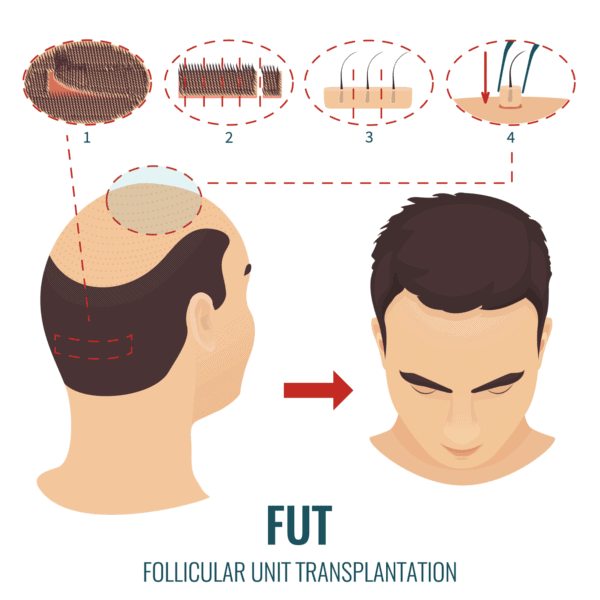
FUT stands for Follicular Unit Transplantation. It is also known as the strip method because a narrow section of hair-bearing skin is removed from the donor area.
The strip is divided under magnification into individual follicular units. These grafts are prepared and placed into the areas where the hair has thinned.
FUT can suit patients who wear their hair longer and want to avoid shaving a wider donor area. Before recommending it, the surgeon will examine the donor hair, check scalp flexibility and discuss the number of grafts required.



FUT stands for Follicular Unit Transplantation. It is often called the strip method because the surgeon removes a narrow strip of hair-bearing scalp from the donor area, usually at the back of the head.
The strip is divided under magnification into the small groups in which hair grows naturally. These follicular-unit grafts are checked, sorted and prepared before they are placed into the thinning area.
Removing the strip leaves a permanent linear scar. The hair around it will often provide cover once the wound has healed, although the scar may be visible with a very short haircut. Its position, length and likely effect on future hairstyles need to be discussed before treatment.
Unlike FUE, FUT does not require individual grafts to be extracted across a broad part of the donor area. This can make it worth considering for selected patients who keep their hair longer or want to avoid wider donor shaving.

The first appointment is used to find out what is causing the hair loss and whether FUT is a sensible option. Dr Harpreet Kalra examines the scalp, the proposed treatment area and the permanent donor hair. He also checks scalp flexibility because enough movement is needed to remove and close the donor strip safely.
Medical history, medication, previous surgery and any existing donor scars are reviewed at the same time. A graft estimate and treatment quotation follow that assessment rather than being based on the size of the bald area alone.
The recipient area is marked before surgery begins. A hairline has to suit the face and allow for future thinning, while crown work must follow the direction of the existing whorl. The design also determines how many fine single-hair grafts and larger follicular units will be needed.
Local anaesthetic is given before a narrow strip of hair-bearing scalp is removed from the planned donor area. The wound is then closed. The closure leaves a permanent line that normally sits beneath the surrounding hair.
The strip is divided under magnification into individual follicular units. Fine single-hair grafts are kept for a soft visible edge, while grafts containing more hairs can be placed behind them for coverage. The recipient sites are made to match the angle, direction and spacing of the surrounding hair.
Patients normally leave the clinic on the day of surgery with written instructions for both the donor wound and the implanted grafts. The aftercare guide covers washing, sleeping, medication and activity, while the growth timeline explains what usually happens over the following months.
FUT is not chosen simply because someone needs a large number of grafts or wants to avoid shaving a wider donor area. The donor hair must be strong enough, and the scalp needs sufficient flexibility for the strip to be removed and the wound closed without excessive tension.
Hair length and usual hairstyle also matter. Longer hair at the back and sides can cover the linear scar left by FUT. Anyone who normally wears this area very short needs to consider whether that scar could become visible.
FUT may be suitable when:
FUT hair transplant prices are quoted individually after consultation.
Our FUE hair transplant prices start from £3,499. See our current graft prices for a guide. Price alone does not determine which method is suitable.
Your exact FUT cost is confirmed after the consultation. The doctor examines the donor area, calculates the graft requirement and agrees the treatment plan with you.
You will receive a confirmed quotation before deciding whether to proceed.
FUT recovery includes care for the donor wound as well as the newly implanted grafts. Tightness, tenderness, altered sensation, redness, swelling and scabbing can occur during the first stage of healing. How long these remain noticeable differs between patients.
The clinic’s instructions will explain how to wash the scalp, protect the recipient area and look after the donor incision. They will also cover exercise, heavy lifting, medication, follow-up and the care or removal of sutures or staples where these are used.
The scar remains after the skin has healed. Hair around the line may conceal it, but its visibility depends on healing, scar width, hair density and haircut length. A widened or raised scar may be harder to cover.
Some transplanted hair shafts usually shed after the early healing period. New hair then appears gradually over the following months. Six months is normally an interim stage, with further length, thickness and maturation through the first year and sometimes beyond it.
Possible problems include bleeding, infection, delayed wound healing, altered sensation, donor tightness, shock loss, uneven graft growth and a scar that becomes wider, raised or more visible than expected. The surrounding native hair may also continue to thin after the transplant.
Severe or increasing pain, heavy bleeding, spreading redness, discharge, fever, breathing difficulty or signs of an allergic reaction need prompt medical attention.
FUT and FUE describe how the grafts are taken from the donor area. DHI normally starts with FUE extraction and changes the way the prepared grafts are placed.
With FUT, the surgeon removes a narrow strip of hair-bearing scalp from the back of the head. The wound is closed, leaving one permanent linear scar. The strip is then divided under magnification into individual follicular-unit grafts.
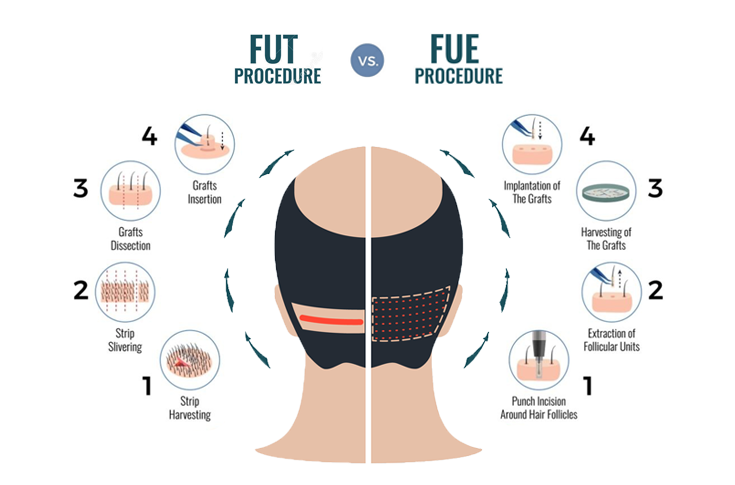
During an FUE hair transplant , follicular units are removed individually from across the planned donor area. This avoids one continuous scar, although each extraction leaves a small round mark. The surgeon must spread the extractions across the donor area so the remaining hair does not look visibly thinned.
A DHI hair transplant normally uses the same individual extraction method as FUE. The prepared grafts are loaded into an implanter device before placement. DHI changes the placement stage; it does not provide another source of donor hair.
The choice depends on the quality of the donor hair, scalp flexibility, the number of grafts required, the patient’s usual hairstyle, previous surgery and the longer-term treatment plan.
Dr Harpreet Kalra assesses patients before FUT is recommended. He examines the pattern of hair loss, the strength of the donor hair and the amount of movement in the scalp. He also considers how many grafts are needed and how the patient normally wears the hair at the back and sides.
FUT leaves a permanent linear scar in the donor area. During the consultation, Dr Kalra explains where that scar is likely to sit, how it could affect shorter hairstyles and whether strip surgery is a sensible use of the available donor hair.
If FUE, DHI or another approach would be more suitable, this is discussed before a treatment plan is agreed. Patients are given a clear explanation of the proposed surgery, recovery and longer-term donor planning.
GMC reference: 7126076

Results matter, but patients also remember how they were looked after. We stay in contact before, during and after treatment so patients know what to expect, have time to ask questions and can speak to the clinic during their recovery.
Our team remains available after the procedure with guidance, support and aftercare advice. The comments below were left for Harley Street Hair Transplants on Google and describe patients’ wider experience of the clinic.
“Great overall service.”
“Very satisfied with my results.”
“Great experience.”