
Men’s Hair Loss and Male Pattern Baldness
Male pattern baldness, medically known as androgenetic alopecia, is the most common form of progressive hair loss in men.
It commonly develops through recession at the frontal hairline and temples, thinning through the top of the scalp, crown hair loss or a combination of these areas.
The pattern and rate of progression can vary considerably. Some men develop relatively limited recession, while others gradually lose density across larger areas of the scalp.
Understanding the cause of the hair loss, its likely progression and the strength of the remaining donor hair is important before deciding whether monitoring, medical treatment or hair-transplant surgery may be appropriate.
What Is Male Pattern Baldness?
Male pattern baldness is a form of non-scarring hair loss in which susceptible follicles gradually become smaller over repeated hair-growth cycles.
Instead of suddenly disappearing, affected follicles usually begin producing progressively finer, shorter and less visible hairs. This process is known as follicular miniaturisation.
As miniaturisation progresses, density through the affected area decreases and more scalp becomes visible. Some follicles may eventually stop producing a visible hair.
DHT and Hair Follicles
Dihydrotestosterone, usually shortened to DHT, is an androgen produced from testosterone. In genetically susceptible scalp follicles, DHT contributes to progressive miniaturisation.
This does not mean that men with male pattern baldness simply have unusually high testosterone. The sensitivity of particular follicles to androgen signalling is an important part of the process.
Is Male Pattern Baldness Genetic?
Genetics play an important role, and male pattern hair loss often runs in families.
Inheritance is complex and is not limited to one gene or one side of the family. Brothers, fathers and sons can therefore develop different patterns and rates of progression.
Does Baldness Only Come From Your Mother's Side?
No. Genetic susceptibility can be inherited through either or both sides of the family. Family history is useful during assessment, but it cannot predict an individual's final pattern with certainty.
Early Signs of Male Pattern Baldness
Male pattern hair loss usually develops gradually rather than appearing overnight. The earliest change may be subtle, particularly where existing hair still provides reasonable coverage.
- progressive recession at the temples;
- a higher or increasingly M-shaped frontal hairline;
- reduced density immediately behind the hairline;
- increasing scalp visibility through the top of the head;
- thinning around the crown or vertex;
- finer and shorter hairs within previously dense areas;
- gradual expansion of frontal and crown hair loss over time.
How Is Male Pattern Baldness Diagnosed?
Assessment usually considers the distribution of the hair loss, how long it has been developing, the rate of progression, family history and the appearance of the scalp and remaining hairs.
Straightforward androgenetic alopecia usually follows a recognisable frontal, top-scalp or crown pattern and does not normally produce significant inflammation or scarring.
Other Causes of Hair Loss
Not every receding, thinning or shedding scalp has male pattern baldness. Hair loss can also occur because of illness, substantial physical stress, nutritional deficiency, medication, autoimmune disease or inflammatory and scarring scalp conditions.
Sudden shedding, clearly defined bald patches, pain, marked itching, redness, scaling or scarring should not simply be assumed to be genetic hair loss.
When Should Hair Loss Be Medically Assessed?
Medical assessment is particularly sensible where hair loss is sudden, unusually rapid, patchy, painful, inflamed, associated with other symptoms or affecting areas that would normally be considered for donor harvesting.
Establishing the cause should come before cosmetic treatment when the diagnosis is unclear.
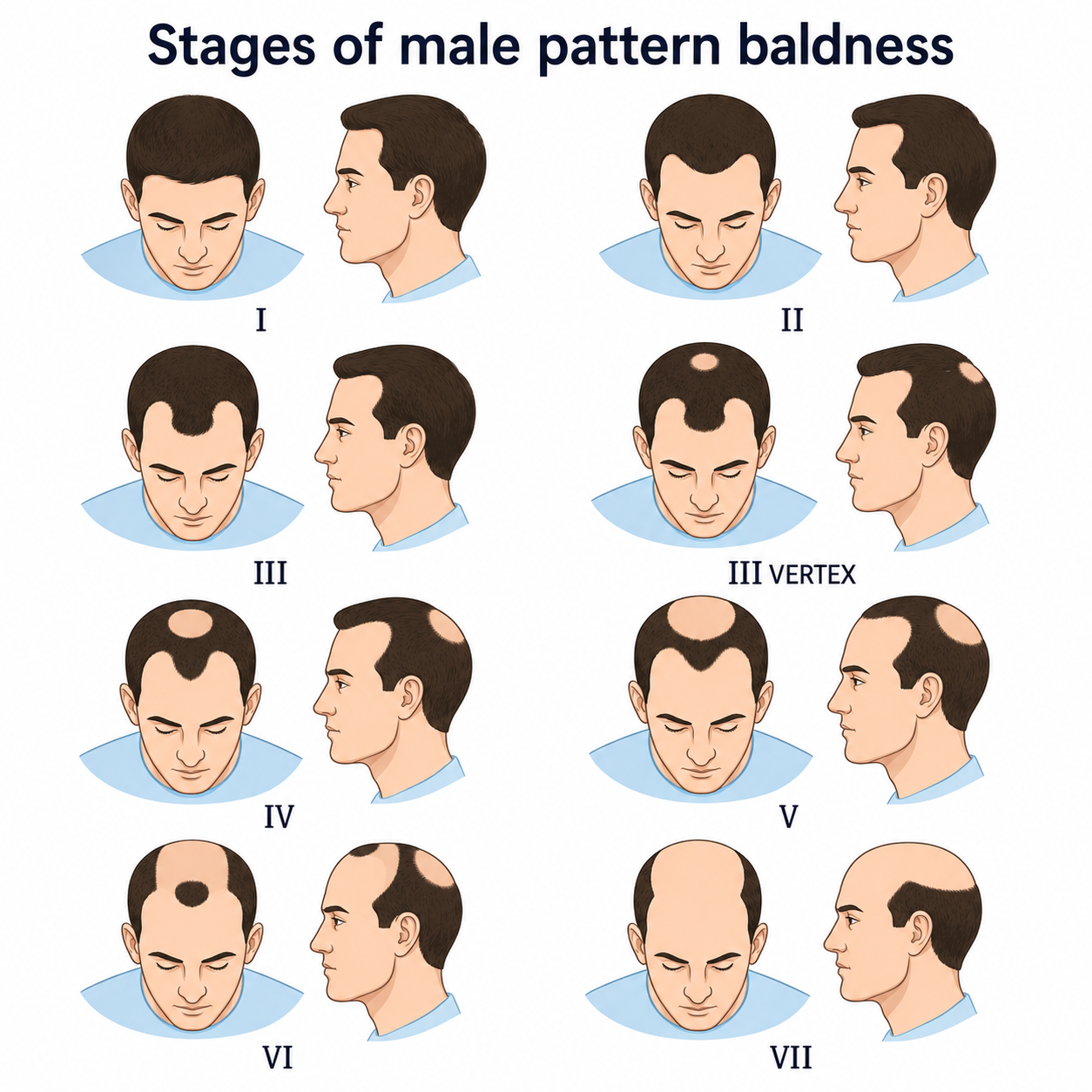
Norwood Stages of Male Pattern Baldness
The Hamilton–Norwood scale is commonly used to describe the location and extent of male pattern hair loss. It provides a useful way to discuss progression, but it does not determine transplant suitability or graft numbers on its own.
At What Age Does Male Pattern Baldness Start?
Male pattern hair loss can become noticeable after puberty, but there is no single age at which it begins. Some men first notice recession or reduced density relatively young, while others retain substantial scalp coverage until much later in life.
The age at which hair loss begins does not tell us exactly how extensive the eventual pattern will become. Progression differs considerably between individuals.
Younger patients require particularly careful long-term planning when considering hair-transplant surgery because their eventual pattern may not yet be clear. A hairline that appears mildly recessed at one point in time may continue to change as the surrounding native hair ages.
This is one reason donor hair should not be treated as an unlimited resource or used solely to recreate the lowest possible hairline at a young age.
How Quickly Does Male Pattern Baldness Progress?
Male pattern baldness usually develops gradually over years rather than appearing suddenly. The rate of change can nevertheless vary substantially.
Some men experience long periods during which the visible pattern changes very little. Others develop progressively greater recession, reduced density through the mid-scalp or enlargement of crown thinning over a shorter period.
Earlier onset can sometimes be associated with more rapid progression, although an individual's final pattern cannot be predicted accurately from age alone.
Photographs taken under similar lighting, with a similar hairstyle and from comparable angles can be useful when trying to determine whether gradual progression is occurring.
Can Male Pattern Baldness Be Prevented?
There is currently no treatment that removes the inherited susceptibility responsible for androgenetic alopecia. Male pattern baldness is driven primarily by genetic susceptibility and androgen-related follicle miniaturisation.
Ordinary shampooing, normal hair washing, wearing hats and routine hairstyling do not explain the characteristic pattern of frontal, top-scalp and crown miniaturisation seen in male pattern baldness.
Appropriate medical treatment may slow progression or help preserve existing hair in some men while susceptible follicles are still active. This is different from preventing the inherited condition altogether.
It is also important to distinguish slowing future hair loss from restoring coverage that has already been lost. Medical treatment may improve or preserve susceptible hair in some patients, but it cannot simply recreate a full supply of follicles in a substantially bald area.
Hair transplantation addresses that problem differently by redistributing suitable existing follicles from a donor area. It can improve coverage in selected areas, but it does not remove the underlying tendency for untreated native hair to continue thinning.
Temporary Hair Loss Is Different
Not every episode of hair loss is androgenetic alopecia. Diffuse shedding can occur after illness, substantial weight loss, significant stress, iron deficiency or other medical problems.
Those forms of hair loss may improve when the underlying trigger or medical cause is addressed. Sudden, patchy, inflamed or unexplained loss should therefore not automatically be treated as male pattern baldness.
Medical Treatment for Male Pattern Baldness
Medical treatment may slow progression or improve hair growth in some men. No treatment works for everybody, and suitability, expected benefit and possible adverse effects should be considered before treatment begins.
The response also depends on factors such as the extent of follicle miniaturisation and how long the affected area has been thinning.
Topical Minoxidil
Minoxidil is applied directly to the affected scalp and is one of the established treatments used for male pattern hair loss.
It may slow progression and may improve hair growth in some men, although the degree of response varies between individuals.
Treatment needs to be continued to maintain its effect. Possible adverse effects can include scalp dryness, redness, scaling or itching, and some users may notice increased shedding during the early treatment period.
Finasteride
Finasteride is a prescription medicine used for male pattern hair loss. It reduces the conversion of testosterone to dihydrotestosterone and may slow further follicle miniaturisation in suitable men.
Some men may also experience improved hair growth, but results vary and any benefit generally depends on continuing treatment.
Finasteride is not suitable for everyone. Recognised adverse effects and individual suitability should be discussed with the prescribing clinician before treatment is started.
PRP Hair Treatment
Platelet-rich plasma treatment involves preparing plasma from the patient's own blood and introducing it into selected areas of the scalp.
PRP does not transplant new follicles and should not be described as a cure for male pattern baldness. Research suggests possible benefit in some patients, but outcomes are variable and the evidence is less established than for the main medical treatments.
Cosmetic Options
Not every approach to male pattern baldness needs to involve medication or surgery. Hair fibres, changes in hairstyle, hair systems and scalp micropigmentation can reduce the visible contrast between the hair and scalp.
These approaches change the appearance of the hair loss rather than altering the underlying process of follicle miniaturisation.
Diagnosis comes first. Treatment intended for androgenetic alopecia is not automatically appropriate for sudden shedding, patchy hair loss, inflammatory scalp disease or scarring alopecia. Where the cause is uncertain, medical assessment should come before cosmetic treatment.
Hair Transplant Surgery for Male Pattern Baldness
A hair transplant redistributes suitable existing follicles rather than creating a new supply of hair. Follicles are taken from an appropriate donor area and placed into selected areas affected by hair loss.
Surgery does not stop untreated native hair from continuing to thin. Planning therefore needs to consider both the hair already lost and the hair that may be affected in future.
FUE Hair Transplant
FUE removes follicular-unit grafts individually from a suitable donor area. It avoids a continuous linear strip scar, although each extraction creates a small healing site.
DHI Hair Transplant
DHI generally uses individual donor-graft extraction similar to FUE and differs mainly in the placement stage, where an implanter device is used to place the prepared grafts.
FUT Hair Transplant
FUT removes a narrow strip of hair-bearing donor scalp and divides it into individual follicular-unit grafts. The donor wound heals with a permanent linear scar.
Crown Hair Transplant
Crown restoration requires careful reconstruction of the natural whorl. The crown can also consume substantial numbers of grafts, particularly when thinning extends over a large area.
Choosing a Treatment Method
No surgical technique is automatically best for every man with androgenetic alopecia. Suitability depends on the treatment area, donor supply, hair characteristics, scalp condition, previous surgery and the longer-term pattern of hair loss.
Donor Area and Long-Term Planning
The donor area is a limited resource. Having visible hair at the back and sides of the scalp does not mean every follicle can or should be harvested.
Donor density, hair calibre, follicular grouping, signs of miniaturisation, previous surgery and the likely future pattern of hair loss all influence how much hair may be available for transplantation.
Donor Density and Hair Characteristics
Extraction needs to leave sufficient hair behind so that the donor region continues to look natural. Excessive harvesting can reduce visible density through the back and sides.
Hair calibre also matters. Coarser hair can create a different visual coverage effect from very fine hair even where the graft numbers are similar.
Planning for Future Hair Loss
Native hair can continue to thin after transplantation. A treatment plan therefore needs to consider where additional loss may occur and whether donor grafts should be preserved for possible future treatment.
This is particularly important when both the frontal scalp and crown are affected. Attempting to maximise density everywhere during one procedure can use grafts that may later be needed elsewhere.
How Many Grafts Are Needed?
There is no universal graft number for a particular Norwood stage. Two men with the same visible stage can have different scalp dimensions, existing density, donor strength, hair calibre and treatment goals.
A graft estimate should therefore follow assessment of both the donor and recipient areas rather than being based on a photograph or Norwood number alone.
Hair Transplant Aftercare
Early aftercare focuses on protecting the implanted grafts, caring for the donor area, washing correctly and avoiding unnecessary rubbing or trauma while the scalp heals.
Hair Transplant Growth Timeline
A transplant does not produce its final appearance immediately. Early shedding can occur before new growth develops gradually over the following months and continues to mature.
Hair Transplant Before & After Results
Before-and-after photographs are most useful when considered alongside the original pattern of hair loss, donor strength, treatment area, graft requirement and the point in the growth timeline when the photographs were taken.