Donor Strip Harvesting
Contents [show] [hide]
- Donor area basics
- Determining the strip size
- How density changes the calculation
- Scalp flexibility and strip width
- What affects the donor scar?
- Surgical technique and closure
- Individual healing and hair characteristics
- Caring for the donor area
- The first two weeks
- The following two to three months
- Later scar maturation
- London consultations
Strip harvesting is the donor collection method used in follicular unit transplantation (FUT). A narrow strip of hair-bearing scalp is removed and divided into individual grafts. The wound is then closed, leaving a permanent linear scar at the back of the head.
Many people find that the surrounding hair covers the healed line well. The amount of cover depends on the scar, hair density and haircut: a close clip or shave can expose a scar that is hidden by longer hair. Understanding how the strip is planned and how the wound heals helps you weigh up whether FUT suits you.
Donor area basics
The donor strip is usually taken from the back of the scalp and may extend towards the sides. Hair in an appropriate donor region is generally more resistant to male pattern hair loss than hair on the top of the head. That region still needs assessing carefully; its boundaries and long-term stability differ between people.
Planning starts with the number of grafts needed, the number of follicular units available in each square centimetre and the movement of the scalp. A follicular unit is a natural grouping of hairs, so the graft count is different from the total hair count. For a given density, collecting more grafts requires a larger area of donor tissue.
Determining the strip size
A dense donor area can supply the same number of grafts from a smaller strip than a less dense area. Hair density also changes across an individual scalp. The back often has a higher concentration of follicular units than the sides, so a single measurement cannot describe the whole planned strip.
Figures such as 60-100 follicular units per square centimetre at the back and 50-80 at the sides are useful examples of the variation described in donor planning. They are not a personal estimate or a universal range. Some areas have too little suitable hair to harvest safely.
The surgeon examines the donor hair under magnification and measures density before deciding the strip dimensions. Those measurements are considered alongside scalp flexibility and the graft requirement. The aim is to obtain the planned grafts while leaving wound edges that can be brought together without excessive tension.
How density changes the calculation
Imagine three patients who each need 2,400 grafts. If their donor densities are 100, 80 and 60 follicular units per square centimetre, they need different areas of scalp to provide that number. Dividing the graft target by the measured density gives the estimated strip area.
| Patient | Density (units/cm²) |
Strip area | Strip length |
|---|---|---|---|
| A | 100 | 24 cm² | 12 cm |
| B | 80 | 30 cm² | 15 cm |
| C | 60 | 40 cm² | 20 cm |
In this example, the highest density provides the graft target from a strip 8 cm shorter than the lowest density. The assumed 2 cm width makes the arithmetic easy to compare; it is not a recommended width. An actual strip may vary in width along its length, and the plan must allow for the patient's scalp and the grafts that can be obtained.
Scalp flexibility and strip width
Density determines how much donor tissue is needed, while scalp movement helps determine its shape. If the scalp moves freely, it may be possible to remove a wider, shorter strip. A tight scalp may require a narrower, longer strip to collect the same number of grafts.
The important limit is the tension needed to close the wound. Pulling the edges together too tightly can affect healing and increase the risk of a wider scar. Flexibility varies between patients and along the donor area, so it is assessed at several points. A loose scalp does not, by itself, guarantee a fine scar or make a wide strip suitable.
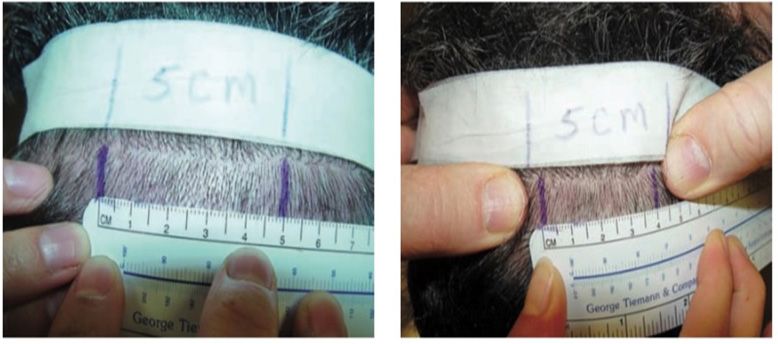
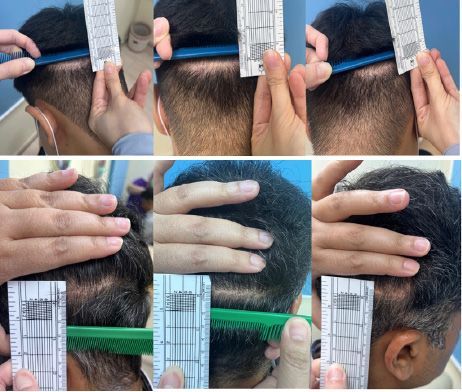
Clinical photographs reproduced from Pathomvanich and Chanwaowarm's study of FUT scar width under its Creative Commons Attribution licence. The examples illustrate assessment and scarring; they do not predict an individual result.
What affects the donor scar?
The healed line reflects several influences working together: how the incision is made and closed, the properties of your skin and your body's healing response, and the care taken while the wound recovers. Careful surgery and aftercare can reduce avoidable problems, but neither can promise an invisible scar.
Discuss previous scars and scalp surgery at the assessment. Your surgeon can explain the likely trade-offs between graft supply, wound tension, scar visibility and the hairstyles you prefer.
Surgical technique and closure
Hair follicles do not all run at the same angle beneath the skin. During harvesting, the surgeon follows their direction along the upper and lower strip edges, adjusting the incision as needed to reduce follicle injury. Magnification helps with this work and with preparing the removed tissue into grafts.
Closing the donor wound is another part of scar planning. The surgeon considers whether to close in one or more layers, whether a standard or trichophytic closure is appropriate, and whether to use stitches or staples. A layered closure can help distribute tension; the choice depends on the wound rather than a single method being right for everyone.
With a trichophytic closure, a narrow edge of skin is carefully trimmed so that some hairs can grow through the healed line. Those hairs may help disguise the scar, although they do not remove it. Stitches and staples each have practical advantages and limitations, which your surgeon will consider when closing the donor site.
Individual healing and hair characteristics
People heal differently, and even the same person can develop different scars in different locations. Skin characteristics, scalp tightness, previous wounds and individual healing all matter. Age is considered as part of the wider assessment, rather than used alone to predict a scar. A noticeable line can develop despite careful technique and appropriate care.
If a linear scar would be a poor fit for you, follicular unit extraction (FUE) may be worth discussing. FUE avoids removing a continuous strip, but it leaves numerous small scars and has its own limits on donor harvesting.
How well hair hides a scar also depends on its length, density, wave or curl, and the contrast between hair and skin colour. Longer, denser hair usually provides more cover. A very short haircut can expose the scalp and the line beneath it, even when the scar itself is narrow.
If you prefer to shave your head, make that clear before choosing a procedure. FUT is generally a poor match for a hairstyle that exposes the donor skin. There is no single safe clipper length that will conceal every patient's scar.
Caring for the donor area
Healing continues well after the surface of the incision has closed. It is helpful to think of recovery in early, intermediate and later phases, although these overlap and their timing varies. Follow the clinic's aftercare instructions for washing, activity and follow-up appointments.
The first two weeks
During the early phase, stitches or staples support the wound while its edges begin to heal. The clinic will explain how to clean the area and protect it. Non-dissolving stitches are commonly removed after about 10-14 days; the timing for your closure will be confirmed at follow-up.
Do not remove stitches or staples yourself. Contact the clinic if the wound opens or you develop increasing redness, swelling, discharge or pain, rather than waiting for the next routine appointment.
The following two to three months
After the stitches or staples have been removed, the new scar tissue is still gaining strength. Over the next few months it can stretch, particularly if repeated tension pulls the wound edges apart. This is an important period for watching whether the scar is becoming wider.
A fine healed line may be around 1-2 mm wide, but that is not a guaranteed result or a strict boundary between normal and abnormal healing. Tell the clinic if you notice widening so that it can be assessed.
Ask your surgeon which movements put tension on your particular incision. Deep forward bending of the neck can pull on the donor area, and exercise may need to be limited temporarily. Follow the individual timetable you are given for returning to activity rather than testing how much stretch the wound will tolerate.
Later scar maturation
From around two to three months onwards, the scar continues to remodel. It may gradually become softer and less pink over the following year, sometimes longer. Changes in colour and texture depend on skin tone and individual healing; a paler line does not prove that all healing is complete.
The donor scar and the transplanted hair also follow different timelines. Attend the recommended reviews so that both can be assessed. The NHS guide to hair transplants provides a general overview of recovery and the risks of FUT and FUE.
London consultations
An assessment with Dr Harpreet Kalra can help establish whether your donor hair, scalp flexibility and preferred hairstyle suit strip harvesting. You can discuss the graft estimate, likely scar, closure method and recovery before deciding on treatment.