
Male hair loss scale
Norwood Stages of Hair Loss
The Norwood scale is commonly used to describe different stages of male pattern hair loss, from early temple recession to more advanced crown and scalp thinning.
Understanding your Norwood stage can help with treatment planning, donor-area assessment, graft estimates, hairline design and realistic expectations before considering a hair transplant.
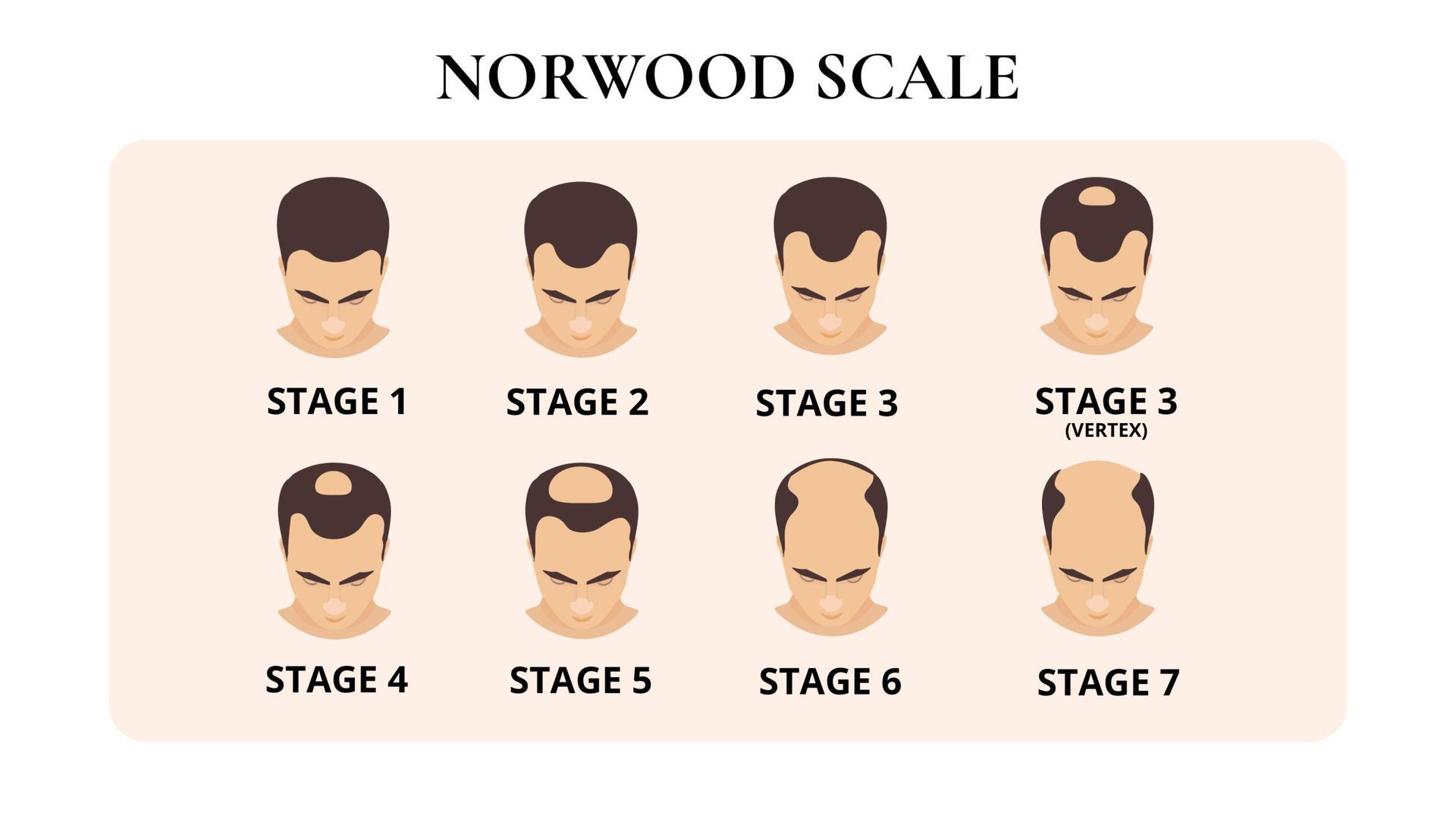
The Norwood scale helps describe common stages of male pattern hair loss.
Surgeon-led planning
Our Surgeon

Hair loss stage affects treatment planning
A Norwood stage can help describe the pattern of hair loss, but treatment planning should also consider donor-area strength, hair calibre, age, medical history, future hair-loss progression and realistic expectations.
Some patients may be suitable for FUE, DHI, FUT, PRP or medical hair-loss support, while others may need a more conservative long-term plan.
Norwood scale guide
What are the Norwood stages?
The Norwood scale is a classification system used to describe common patterns of male hair loss. It helps patients and clinics discuss whether the main concern is temple recession, frontal thinning, crown thinning or more advanced scalp hair loss.
The scale is useful, but it does not replace a proper assessment. Two patients with the same Norwood stage can have very different donor areas, hair thickness, age-related progression and treatment suitability.
Stage-by-stage guide
Norwood stages explained
Norwood Stage 1
Little or no visible recession. The hairline is generally intact, although some natural variation is normal.
Norwood Stage 2
Mild temple recession may be visible. Some patients describe this as a mature hairline rather than clear balding.
Norwood Stage 3
More noticeable recession at the temples or frontal hairline. Some patients may begin considering hairline restoration at this stage.
Norwood Stage 3 Vertex
Hairline recession may be combined with early crown thinning. Treatment planning should consider both areas carefully.
Norwood Stage 4
More advanced frontal recession and crown thinning may be present, with a band of hair separating the front and crown areas.
Norwood Stage 5
Frontal and crown thinning become more pronounced. Graft planning and donor preservation become especially important.
Norwood Stage 6
The frontal and crown areas may merge into a larger area of hair loss. A conservative plan may be needed because donor hair is limited.
Norwood Stage 7
Advanced hair loss with a larger bald area across the top of the scalp. Suitability depends heavily on donor-area quality and realistic goals.
Treatment planning
Which Norwood stages may suit a hair transplant?
Early to moderate hair loss
Patients with early or moderate recession may be suitable for hairline, temple or crown restoration if the donor area is strong and hair loss appears stable enough for surgery.
At this stage, planning should avoid lowering the hairline too aggressively because future hair loss may continue.
Advanced hair loss
Patients with advanced hair loss may still be assessed, but expectations need to be realistic. Donor hair is limited, so full density across every thinning area may not be possible.
A staged or conservative approach may be discussed depending on donor supply and goals.
Planning factors
Norwood stage is not the full picture
Donor area
The donor area determines how many grafts may be safely available. This affects hairline design, crown planning and future treatment options.
View Donor Area GuideHair-loss stability
If hair loss is progressing quickly, treatment planning may need to be more cautious. Future thinning should be considered before choosing a hairline design.
View Timeline GuideTreatment method
FUE, DHI and FUT may be discussed depending on donor area, hair type, graft numbers, treatment area and patient suitability.
View FUE Hair TransplantNorwood Stages FAQs
What is the Norwood scale?
The Norwood scale is used to describe common stages of male pattern hair loss, from mild recession to more advanced hair loss across the scalp.
Which Norwood stage needs a hair transplant?
There is no single stage where everyone needs a hair transplant. Suitability depends on donor area, hair-loss stability, goals, medical history and realistic expectations.
Can Norwood Stage 2 be treated?
Some patients with Norwood Stage 2 may not need surgery. Others may be assessed if the recession is affecting the hairline and the pattern is suitable for treatment.
Can Norwood Stage 6 or 7 have a hair transplant?
Some advanced cases may be assessed, but planning must be realistic. Donor hair is limited, so full density across every thinning area may not be possible.
Does the Norwood stage show how many grafts I need?
It can help guide discussion, but graft numbers depend on donor area, hair calibre, density goals, treatment area size and the planned design.
Latest hair transplant advice
Read Harley Street Hair Transplants guides on Norwood stages, hairline recession, crown thinning, donor area, FUE, DHI, FUT, PRP, cost, recovery and results.

Want to understand your Norwood stage?
Contact Harley Street Hair Transplants to discuss your hair-loss pattern, donor-area suitability, treatment options, graft planning, cost, recovery and realistic expectations.
Explore more hair transplant pages
Learn more about treatment options, cost, recovery, aftercare and clinic locations.
