Crown and vertex hair restoration in London
Crown Hair Transplant London
A crown hair transplant restores thinning or balding areas at the crown, also called the vertex. Crown work needs careful planning because the hair grows in a whorl or spiral pattern, and the area can require a high number of grafts. At Harley Street Hair Transplants, crown restoration may be planned using FUE hair transplant, DHI hair transplant or FUT hair transplant depending on your donor area and treatment goals.
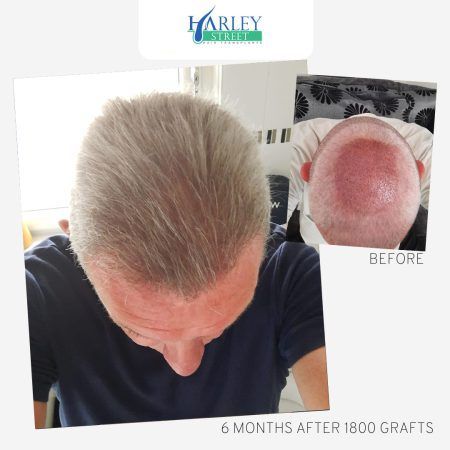
Example crown hair transplant result. Individual results vary and suitability must be assessed before treatment.
What is a crown hair transplant?
A crown hair transplant is a surgical hair restoration procedure for thinning or balding at the top and rear part of the scalp. The crown is one of the most technically demanding areas because the hair changes direction around the natural whorl.
The procedure involves taking healthy donor hairs from a suitable area, usually the back or sides of the scalp, and implanting them into the crown. The aim is to improve coverage while preserving enough donor hair for future hair loss planning.
Who may be suitable for crown restoration?
Crown transplant may help with:
- male pattern hair loss affecting the crown;
- visible vertex thinning;
- expanding crown bald spots;
- crown and mid-scalp thinning;
- selected female crown thinning cases after assessment;
- patients with suitable donor hair;
- patients with realistic density expectations.
It may not be suitable if:
- the donor area is weak or overused;
- hair loss is rapidly progressing;
- medical scalp conditions are untreated;
- the area needs more grafts than safely available;
- expectations are unrealistic;
- PRP, medication or monitoring is a better first step.
Crown thinning can have different causes. A consultation should review your hair-loss pattern, donor area, medical history, scalp health, family history and treatment goals before surgery is recommended.
How a crown hair transplant works
Consultation and diagnosis
The crown is assessed to understand whether the thinning is stable, progressive, diffuse or linked to another scalp condition. Your donor area, age, hair calibre, medical history and expectations are reviewed.
Crown graft planning
The crown often needs more grafts than patients expect. Planning must balance coverage with donor preservation, especially if the hairline, mid-scalp or future hair loss also needs treatment.
Placement into the crown whorl
The grafts are placed into the crown following the natural spiral or whorl pattern. Direction control is important because the crown is visible from above and can look unnatural if angles are poorly planned.
Aftercare and growth monitoring
Aftercare should cover washing, scab care, sleeping, exercise, donor-area care, shedding and follow-up. Crown growth is gradual, and final maturity may take longer than hairline work.
FUE, DHI, FUT and PRP for crown thinning
Crown thinning does not always need immediate surgery. Some patients are better suited to PRP, medication or monitoring before a transplant is considered. The right plan depends on the stage of hair loss and the donor area.
| Option | How it may help | Key point |
|---|---|---|
| FUE | Individual grafts are extracted and placed into the crown. | Common option for crown restoration, but donor-area planning is critical. |
| DHI | Uses FUE-style extraction with implanter-device placement. | May suit selected crown cases, but it is not automatically better for everyone. |
| FUT | Uses a donor strip that is dissected into grafts. | May be discussed for selected graft-number planning but leaves a linear donor scar. |
| PRP | Non-surgical treatment that may support selected thinning areas. | May help selected patients with early thinning, but it does not replace lost follicles. |
Why crown hair transplants are more complex
Whorl direction
Crown hair grows in a spiral pattern. The grafts must follow this direction to avoid an artificial appearance.
Large treatment area
Crown baldness can spread across a wide area, which means graft demand can be high.
Slower maturity
Crown results often mature more slowly than frontal hairline results and should not be judged too early.
Donor preservation
The crown can use many grafts, so donor hair must be protected for future hair loss planning.
Diffuse thinning
Some crown thinning is diffuse, especially in some female hair-loss patterns, and may need medical assessment first.
Ongoing hair loss
A crown transplant does not stop surrounding native hair from continuing to thin over time.
Crown transplant recovery and aftercare
Early recovery can include redness, scabbing, tightness, swelling and donor-area tenderness. FUE recovery is often focused on the first 7–10 days, while FUT donor healing can take longer because of the linear incision.
Aftercare usually includes:
- avoiding rubbing or scratching the crown;
- sleeping as advised to protect grafts;
- washing only as instructed;
- not picking scabs;
- avoiding heavy sweating early on;
- following donor-area aftercare instructions.
Growth timeline
Crown growth develops gradually. Early visible improvement may begin after several months, but crown maturity can take longer than frontal hairline work.
Crown hair transplant cost in London
Crown hair transplant cost depends on the number of grafts required, the size of the thinning area, the chosen method, donor-area suitability, case complexity and aftercare requirements. The current crown page explains that a typical hair transplant cost can be around £4,000, but your exact quote should follow assessment.
Cost depends on:
- size of the crown thinning area;
- number of grafts required;
- whether FUE, DHI or FUT is used;
- whether crown and mid-scalp are treated together;
- donor-area quality;
- aftercare and review requirements.
View prices and book
A proper quote should follow consultation and donor assessment. You can view the price guide or book a consultation to discuss crown restoration.
Google reviews
Patient reviews can help you understand the consultation process, treatment experience, aftercare and communication before booking. Read current Google reviews alongside your consultation, treatment plan and realistic expectations.
Reviews may not display inside the Snapps editor. Republish and check the live page in a normal browser tab.
