Strip hair transplant in London
FUT Hair Transplant London
FUT stands for Follicular Unit Transplantation. It is also known as strip surgery because a strip of donor scalp is removed, dissected into follicular-unit grafts and then implanted into thinning or balding areas. At Harley Street Hair Transplants, FUT may be discussed for selected patients, but many patients are now better suited to FUE or DHI after donor-area assessment.
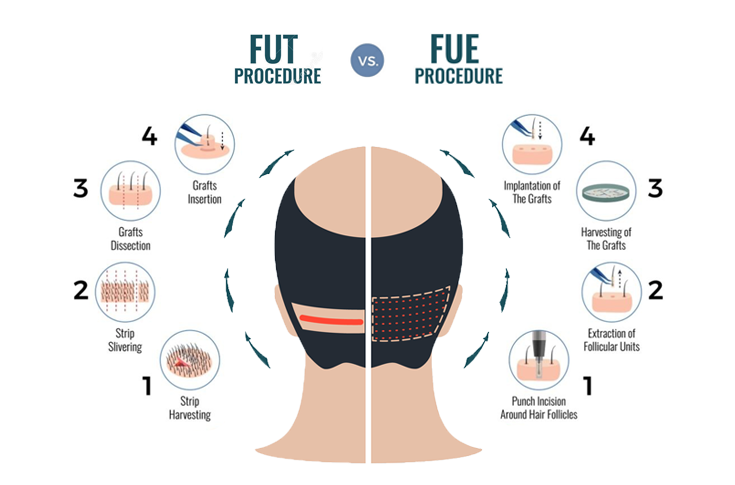
Educational FUT vs FUE comparison image. Treatment suitability must be assessed individually.
What is a FUT hair transplant?
FUT is a surgical hair restoration method where a strip of scalp is removed from the donor area, usually from the back of the head. The strip is then divided into smaller follicular-unit grafts under magnification before being placed into the planned recipient area.
FUT can produce usable graft numbers in selected cases, but it is more invasive than FUE and leaves a linear donor scar. This is why the consultation should compare FUT carefully with FUE hair transplant, DHI hair transplant and non-surgical options before a decision is made.
Who may be suitable for FUT?
FUT may be discussed when:
- a patient needs a larger graft number;
- the donor area is suitable for strip harvesting;
- scalp laxity is appropriate;
- the patient is comfortable with a linear scar;
- the hair is usually worn long enough to cover the donor area;
- FUE alone may not be the strongest plan.
FUT may not be suitable when:
- the patient wants very short hair at the back and sides;
- the donor area is weak or unstable;
- scalp laxity is poor;
- the patient wants to avoid a linear scar;
- the treatment area can be managed better with FUE or DHI;
- medical history makes surgery unsuitable.
The donor area must be assessed carefully before FUT is recommended.
How the FUT procedure works
Design and graft planning
The treatment area is planned before surgery. A hairline transplant must be natural and age-appropriate, while a crown hair transplant needs careful graft management because the crown can use many grafts.
Strip harvesting
A strip of donor scalp is removed from the back of the head. The donor area is then closed, leaving a linear scar. Scar visibility depends on healing, closure, hair length and individual factors.
Graft dissection
The strip is divided into follicular-unit grafts. The team then prepares the grafts for placement into the recipient area.
Implantation and aftercare
Grafts are placed into the planned area at the correct angle, direction and density. Aftercare should cover wound care, sleeping, washing, swelling, exercise, scar care, shedding and the normal hair transplant timeline.
FUT vs FUE vs DHI
FUT, FUE and DHI are different methods of hair restoration. The best option depends on the patient, not just the name of the procedure.
| Technique | How it works | Key point |
|---|---|---|
| FUT | A strip of donor scalp is removed and dissected into follicular-unit grafts. | Can offer graft numbers in selected cases but leaves a linear donor scar. |
| FUE | Individual follicular units are extracted from the donor area one by one. | No linear strip scar, but still creates small round extraction scars. |
| DHI | Usually combines FUE-style extraction with implanter-device placement. | Can suit selected cases but is not automatically better for every patient. |
What can FUT treat?
Advanced hair loss
FUT may be discussed where larger graft numbers are needed and the donor area is suitable.
Hairline restoration
A hairline transplant must be planned carefully so the front edge looks natural, soft and age-appropriate.
Crown thinning
A crown hair transplant needs realistic expectations because the crown often requires many grafts and can mature slowly.
Mid-scalp thinning
FUT may be considered where mid-scalp coverage is part of a larger restoration plan.
Combined planning
Some patients need staged planning involving FUE, FUT, medication or PRP treatment.
Long-term hair loss
Future hair loss should be considered before using large graft numbers in one area.
FUT recovery and scar planning
FUT recovery can involve more donor-area tightness and longer healing than FUE because a strip incision is closed with sutures or staples. The linear scar may be hidden by surrounding hair, but it should be discussed honestly before surgery.
Recovery planning should cover:
- donor-area wound care;
- sleeping position and early protection;
- when washing can begin;
- exercise and heavy lifting restrictions;
- scar visibility and haircut length;
- shedding and expected growth stages.
Read before surgery
Read the aftercare guide, hair transplant shedding guide and hair transplant timeline before booking.
FUT hair transplant cost
FUT cost depends on graft numbers, treatment area, donor suitability, scalp laxity, case complexity and aftercare requirements. A proper quote should follow assessment rather than being based only on a headline figure.
Cost depends on:
- number of grafts required;
- size of the treatment area;
- whether the hairline, crown or both are treated;
- donor-area suitability;
- procedure complexity;
- aftercare and review requirements.
View costs and booking options
Visit the hair transplant cost page for pricing information, or read about the no-deposit scheme if you want to understand booking and payment options.
Google reviews
Patient reviews can help you understand the consultation process, treatment experience, aftercare and communication before booking. Read current Google reviews alongside your consultation, treatment plan and realistic expectations.
Reviews may not display inside the Snapps editor. Republish and check the live page in a normal browser tab.
Before and after FUT results
Before and after examples can help patients understand potential improvement, but they should not be treated as a guarantee. Results vary depending on donor supply, graft survival, hair type, native hair, aftercare and the original treatment plan.
Use results properly
Compare cases with similar hair type, hair-loss pattern, graft numbers and treatment area.
View gallery
Visit the before and after results page to review examples before booking a consultation.
